English
 Español
 tiếng việt
 русский
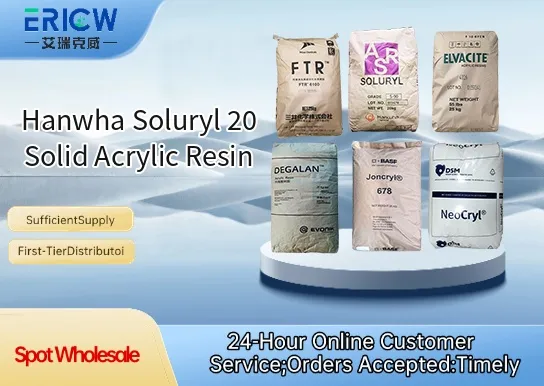
High molecular weight solid acrylic polymer offering excellent film-forming capability and mechanical strength.
Superior UV resistance and long-term color stability for outdoor durability.
Good compatibility with common solvents, cellulose esters, and other thermoplastic resins.
Low volatile organic compound (VOC) contribution when formulated into solvent-borne coatings.
Consistent batch-to-batch quality ensured by controlled free-radical polymerization process.
Automotive refinish clearcoats and basecoats.
Industrial maintenance coatings for metal and plastic substrates.
Architectural high-gloss decorative topcoats.
Coil coating primers and topcoats requiring weatherability and hardness.
Plastic coatings for electronics housings and consumer appliances.
| Chemical Type | Solid acrylic copolymer |
| Product Form | Free-flowing white to off-white granular solid |
| Appearance | Granular, non-dusty, free of visible impurities |
| Glass Transition Temperature (Tg) | ~105 °C (DSC, 10 °C/min) |
| Molecular Weight (Mw) | ~250,000–350,000 g/mol (GPC, PMMA standard) |
| Acid Number | < 5 mg KOH/g |
| Volatile Content | < 1.0 wt% (at 120 °C, 2 hrs) |
| Primary Applications | High-performance solvent-borne industrial and automotive coatings |
Q1: What is the primary function of Hanwha Soluryl 20 in coating formulations?
A: Hanwha Soluryl 20 is a solid acrylic resin designed to serve as a film-forming binder and rheology modifier in high-performance solvent-based and high-solids coatings. It contributes to gloss development, surface hardness, and long-term durability while supporting good flow and leveling characteristics.
Q2: Is Hanwha Soluryl 20 suitable for use in food-contact coatings?
A: While Hanwha Soluryl 20 is not inherently restricted for food-contact applications, its suitability depends entirely on the full formulation—including solvents, crosslinkers, and additives—as well as compliance with applicable regional regulatory frameworks. End-use approval requires comprehensive migration testing and regulatory review by qualified experts.
Q3: How does Hanwha Soluryl 20 compare to liquid acrylic resins in terms of handling and formulation flexibility?
A: As a solid resin, Hanwha Soluryl 20 offers enhanced storage stability and reduced volatility versus liquid alternatives. It allows formulators greater control over VOC content and enables tailored dissolution profiles during manufacturing—though it typically requires elevated temperature or extended mixing time for complete incorporation into the vehicle.
Q4: What types of curing systems are compatible with Hanwha Soluryl 20?
A: Hanwha Soluryl 20 is commonly formulated with amino resins (e.g., melamine-formaldehyde) for thermosetting applications, and it may also be used in ambient-cure or UV-assisted systems depending on co-resins and functionalization. Compatibility should always be verified through small-scale trials under intended processing conditions.
Contact With Us:
E-mail: wangxingqiang@ericwchem.com
Have a Questions? Call Us:
Add:
Building A1, Jiete Industrial Park, Huangpu District, Guangzhou City, Guangdong Province, China