English
 Español
 tiếng việt
 русский
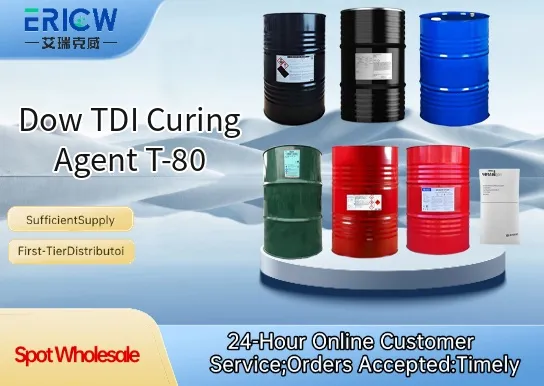
High reactivity with polyols, enabling rapid cure kinetics for efficient production cycles.
Excellent compatibility with aromatic and aliphatic polyether/polyester polyols in two-component systems.
Delivers superior mechanical properties—including tensile strength and abrasion resistance—in cured elastomers.
Low viscosity at ambient temperature facilitates easy handling, metering, and homogeneous mixing.
Consistent batch-to-batch performance supported by Dow’s stringent quality control and traceability protocols.
Cast polyurethane elastomers for industrial rollers, mining screens, and hydraulic seals.
Reaction injection molding (RIM) components in automotive and agricultural equipment.
High-performance coatings and linings for chemical-resistant tank interiors and piping systems.
Flexible and rigid PU foams requiring enhanced dimensional stability and load-bearing capacity.
Adhesives and sealants demanding fast fixture time and long-term bond integrity under thermal cycling.
| Chemical Type | Aromatic diisocyanate-based curing agent (TDI-derived) |
| Product Form | Liquid |
| Appearance | Clear to pale yellow liquid |
| Primary Applications | Two-component polyurethane elastomers, coatings, adhesives, and RIM systems |
| Key Features | Fast-reacting, low-viscosity, high-functionality crosslinker |
| Storage Conditions | Store in original sealed container at 15–25°C; protect from moisture and direct sunlight |
| Handling Precautions | Use in well-ventilated areas; avoid skin contact and inhalation of vapors or aerosols |
| Regulatory Compliance | REACH registered; complies with applicable OSHA and GHS hazard communication standards |
Q1: What is the primary function of Dow TDI Curing Agent T-80 in polyurethane systems?
A: Dow TDI Curing Agent T-80 is a blocked aromatic isocyanate designed to serve as a latent curing agent for hydroxyl-functional resins—particularly in two-component polyurethane coatings, adhesives, and sealants. It remains stable at ambient temperatures but releases active TDI upon thermal activation, enabling controlled crosslinking without premature reaction.
Q2: At what temperature does T-80 typically deblock and become reactive?
A: Deblocking generally begins above 120 °C and proceeds efficiently between 130 °C and 160 °C, depending on formulation composition, film thickness, and heating rate. Optimal cure profiles should be established through application-specific thermal studies.
Q3: Is T-80 compatible with common polyester, acrylic, or polyether polyols?
A: Yes—T-80 demonstrates broad compatibility with hydroxyl-containing resins including saturated polyester, acrylic, and polyether polyols. Compatibility and final film properties (e.g., hardness, flexibility, chemical resistance) are formulation-dependent and require evaluation under intended processing conditions.
Q4: How should T-80 be handled and stored to maintain stability?
A: Store in tightly sealed containers under dry, cool conditions (below 30 °C) and protect from moisture, direct sunlight, and excessive heat. Avoid prolonged exposure to ambient humidity during handling, as moisture can lead to premature deblocking or CO₂ evolution. Use appropriate personal protective equipment (PPE) consistent with industrial isocyanate handling practices.
Q5: Can T-80 be used in low-VOC or high-solids coating formulations?
A: Yes—T-80 is commonly incorporated into high-solids and solvent-reduced polyurethane systems due to its low volatility in the blocked state and efficient thermal activation. Its use supports VOC reduction strategies when formulated with low-VOC resins and solvents, though final compliance depends on the full formulation and regulatory context.
Contact With Us:
E-mail: wangxingqiang@ericwchem.com
Have a Questions? Call Us:
Add:
Building A1, Jiete Industrial Park, Huangpu District, Guangzhou City, Guangdong Province, China