English
 Español
 tiếng việt
 русский
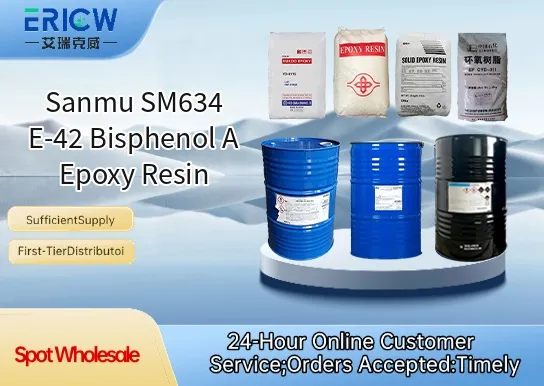
High purity Bisphenol A-based epoxy resin with consistent molecular weight distribution.
Optimized for excellent adhesion to metals, composites, and cured polymer substrates.
Low viscosity (12,000–14,000 cP at 25°C) enabling easy processing and improved wetting in formulations.
Superior thermal stability and chemical resistance after curing with standard amine or anhydride hardeners.
Compliant with RoHS and REACH regulations; free of intentional bisphenol F and halogenated solvents.
Electrical encapsulation and potting compounds for power modules and transformers.
Structural adhesives in automotive and aerospace composite bonding.
High-performance coating systems for corrosion protection of steel infrastructure.
Matrix resin for fiber-reinforced laminates used in wind turbine blades and marine components.
Printed circuit board (PCB) solder mask and dielectric layer formulations.
| Chemical Type | Bisphenol A diglycidyl ether (DGEBA) epoxy resin |
| Product Form | Clear to pale yellow viscous liquid |
| Appearance | Transparent, slightly yellow, homogeneous liquid |
| Epoxy Equivalent Weight (EEW) | 470–490 g/eq |
| Viscosity (25°C) | 12,000–14,000 cP |
| Chloride Content | ≤ 800 ppm |
| Softening Point | 12–15°C |
| Volatiles (150°C, 2 h) | ≤ 0.3 wt% |
Q1: What is the typical viscosity range of SM634 E-42 at 25°C?
A: SM634 E-42 exhibits medium-viscosity characteristics suitable for solvent-free or low-solvent formulations. Its viscosity generally ranges from approximately 10,000 to 25,000 mPa·s at 25°C, making it well-suited for applications requiring good flow and wetting without excessive thinning agents.
Q2: How does SM634 E-42 compare to standard liquid DGEBA resins in terms of epoxy equivalent weight (EEW)?
A: SM634 E-42 has a higher molecular weight than conventional low-molecular-weight DGEBA resins, resulting in a correspondingly higher epoxy equivalent weight—typically above 400 g/eq. This contributes to improved toughness, reduced shrinkage, and enhanced chemical resistance in cured systems.
Q3: Is SM634 E-42 compatible with common amine and anhydride curing agents?
A: Yes, SM634 E-42 demonstrates broad compatibility with aliphatic and cycloaliphatic amines, as well as aromatic amines and carboxylic anhydrides. Cure kinetics and final properties will vary depending on the selected hardener and formulation conditions, so optimization through small-scale trials is recommended.
Q4: Can SM634 E-42 be used in high-performance composite laminates?
A: Yes, due to its balanced reactivity, good adhesion to fibers, and ability to yield thermosets with elevated heat distortion temperature and mechanical integrity, SM634 E-42 is frequently employed in structural composites—including wind blade components, aerospace prepregs, and industrial tooling—often in hybrid or modified resin systems.
Contact With Us:
E-mail: wangxingqiang@ericwchem.com
Have a Questions? Call Us:
Add:
Building A1, Jiete Industrial Park, Huangpu District, Guangzhou City, Guangdong Province, China