English
 Español
 tiếng việt
 русский
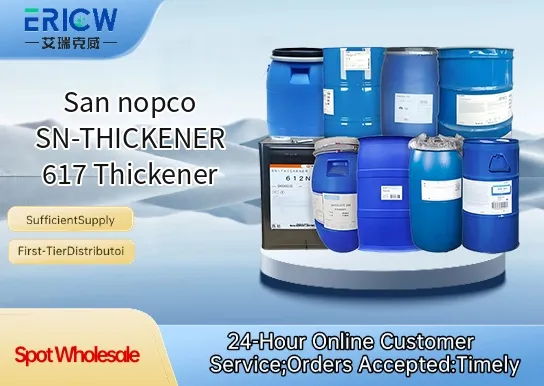
High-efficiency associative thickening for stable rheology control in water-based systems.
Excellent compatibility with anionic, nonionic, and amphoteric surfactants.
Low-foaming performance ideal for high-shear industrial cleaning and coating formulations.
Enhanced viscosity recovery after mechanical stress (thixotropic behavior).
Stable across broad pH range (pH 4–12), supporting formulation flexibility.
Architectural paints and interior/exterior wall coatings.
Industrial and institutional cleaning products (e.g., floor cleaners, degreasers).
Water-based adhesives and sealants.
Textile printing pastes and pigment dispersions.
Agrochemical suspension concentrates (SC formulations).
| Chemical Type | Hydrophobically modified ethoxylated urethane (HEUR) thickener |
| Product Form | Clear to slightly hazy liquid |
| Appearance | Colorless to pale yellow viscous liquid |
| pH (1% aqueous solution) | 6.5 – 8.5 |
| Active Content | 30.0 ± 1.0 wt% |
| Viscosity (Brookfield DV-II+, spindle #3, 20 rpm, 25°C) | 1,500 – 3,500 cP |
| Solubility | Readily dispersible in water; requires mild agitation for uniform incorporation |
| Storage Stability | 12 months unopened at 5–30°C; avoid freezing |
Q1: What types of systems is SN-THICKENER 617 most commonly used in?
A: SN-THICKENER 617 is primarily formulated for use in water-based industrial coatings, architectural paints, and certain agrochemical suspensions where stable, shear-thinning rheology and good sag resistance are required.
Q2: How does SN-THICKENER 617 differ from conventional associative thickeners?
A: Unlike many hydrophobically modified ethoxylated urethanes (HEURs), SN-THICKENER 617 is designed to deliver robust thickening performance with reduced sensitivity to surfactants and co-solvents, offering improved compatibility in complex, multi-component formulations.
Q3: Is SN-THICKENER 617 suitable for low-VOC or zero-VOC formulations?
A: Yes — SN-THICKENER 617 contains no added APEOs or volatile organic carriers, making it compatible with modern low-VOC and zero-VOC regulatory requirements when used as directed in aqueous systems.
Q4: What is the typical dosage range for effective viscosity modification?
A: Effective dosage generally ranges from 0.1% to 2% by weight of the total formulation, depending on the target viscosity, pigment loading, and presence of other rheology modifiers — optimization is recommended via small-scale lab trials.
Q5: Does SN-THICKENER 617 require pH adjustment or activation prior to use?
A: No — SN-THICKENER 617 is non-ionic and functions effectively across a broad pH range (approximately 4–10) without requiring neutralization or pre-dilution, simplifying incorporation into standard manufacturing processes.
Contact With Us:
E-mail: wangxingqiang@ericwchem.com
Have a Questions? Call Us:
Add:
Building A1, Jiete Industrial Park, Huangpu District, Guangzhou City, Guangdong Province, China