English
 Español
 tiếng việt
 русский
Excellent abrasion and wear resistance for demanding mechanical service conditions.
Broad processing window compatible with extrusion, injection molding, and calendering.
Good low-temperature flexibility down to –30 °C without significant loss of elasticity.
Outstanding oil, grease, and hydrocarbon resistance compared to conventional thermoplastics.
High tensile strength and elongation at break, enabling durable dynamic part performance.
Industrial conveyor belts and scraper blades requiring high wear resilience.
Automotive interior trim components including instrument panel overlays and gearshift boots.
Flexible hoses and tubing for pneumatic and hydraulic systems.
Roller covers and printing press rollers demanding dimensional stability and surface fidelity.
Protective casings and gaskets for electronic enclosures and portable equipment.
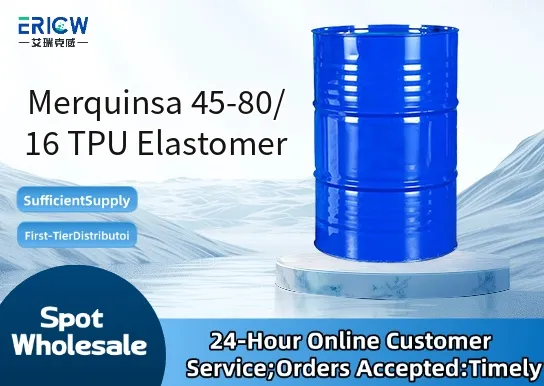
| Chemical Type | Aliphatic polyester-based thermoplastic polyurethane (TPU) |
| Product Form | Pellets |
| Appearance | Off-white to light beige granules |
| Shore A Hardness | 80 ± 2 |
| Melt Flow Index (230 °C / 2.16 kg) | 16 ± 3 g/10 min |
| Density | 1.18–1.20 g/cm³ |
| Primary Applications | Dynamic elastomeric parts requiring toughness, flexibility, and chemical resistance |
| Key Features | Processing versatility, mechanical robustness, and environmental stability |
Q1: What is the primary chemical composition and structural class of Merquinsa 45-80/16?
A: Merquinsa 45-80/16 is a thermoplastic polyurethane (TPU) elastomer based on polyester chemistry, featuring a segmented copolymer structure with alternating hard segments (typically aromatic diisocyanate and chain extender) and soft segments (polyester diol). Its formulation delivers a balanced combination of elasticity, mechanical strength, and melt-processability.
Q2: Is this TPU suitable for extrusion and injection molding applications?
A: Yes — Merquinsa 45-80/16 is specifically engineered for conventional thermoplastic processing methods, including single-screw and twin-screw extrusion, injection molding, and calendering. It exhibits good melt stability, low viscosity at processing temperatures, and rapid solidification, supporting high-throughput production of flexible profiles, films, and molded parts.
Q3: How does this grade perform in terms of hydrolytic stability and resistance to microbial growth?
A: As a polyester-based TPU, Merquinsa 45-80/16 offers moderate hydrolytic resistance under ambient conditions but may be susceptible to degradation in prolonged high-humidity or elevated-temperature aqueous environments. For extended service life in humid or wet applications, stabilization additives or post-processing drying protocols are recommended. It does not inherently support microbial growth, though surface contamination may occur if exposed to organic soiling in warm, moist settings.
Q4: Can Merquinsa 45-80/16 be blended with other polymers or compounded with fillers and additives?
A: Yes — it demonstrates good compatibility with common thermoplastic elastomers such as other TPUs, certain TPEs, and functionalized polyolefins when properly melt-mixed. It also accepts standard plasticizers, UV stabilizers, antioxidants, and mineral fillers. Compatibility and dispersion efficiency should be verified experimentally for each specific formulation, particularly when targeting enhanced stiffness, flame retardancy, or weatherability.
Contact With Us:
E-mail: wangxingqiang@ericwchem.com
Have a Questions? Call Us:
Add:
Building A1, Jiete Industrial Park, Huangpu District, Guangzhou City, Guangdong Province, China