English
 Español
 tiếng việt
 русский
Excellent abrasion resistance for extended service life in demanding mechanical environments.
High transparency and optical clarity suitable for premium aesthetic applications.
Good low-temperature flexibility down to –40 °C without significant loss of elasticity.
Outstanding processability via extrusion, injection molding, and blow molding.
Hydrolysis-resistant formulation ideal for humid or wet-condition applications.
Medical tubing and fluid delivery systems requiring biocompatibility and kink resistance.
High-clarity protective films for electronic displays and touch panels.
Wear-resistant components in automotive interior trim and seals.
Precision extruded profiles for industrial hoses and pneumatic lines.
Soft-touch overmolding on consumer electronics and handheld devices.
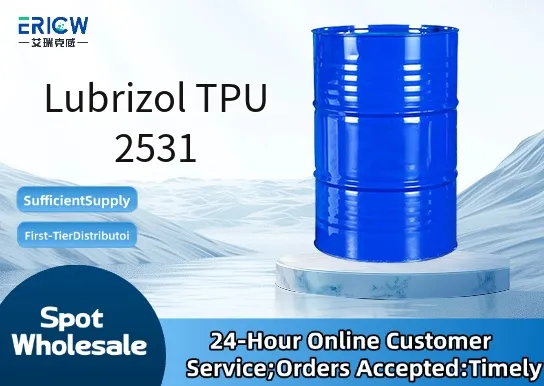
| Chemical Type | Aliphatic polyester-based thermoplastic polyurethane |
| Product Form | Natural pellets |
| Appearance | Transparent, translucent to slightly hazy |
| Hardness (Shore A) | 92–94 |
| Melt Flow Rate (230 °C / 2.16 kg) | 10–14 g/10 min |
| Density | 1.18–1.20 g/cm³ |
| Primary Applications | Extrusion, injection molding, blow molding |
| Key Features | Clarity, hydrolytic stability, low-temperature flexibility |
Q1: What is Lubrizol TPU 2531 primarily used for?
A: Lubrizol TPU 2531 is a thermoplastic polyurethane-based additive designed to enhance melt processability, surface finish, and low-temperature flexibility in TPU compounds—particularly in extrusion and injection molding applications for automotive interior parts, cables, and flexible industrial components.
Q2: Is Lubrizol TPU 2531 compatible with other TPU grades beyond Lubrizol’s own portfolio?
A: Yes, TPU 2531 demonstrates broad compatibility with aromatic and aliphatic TPU resins from multiple suppliers. Compatibility should be confirmed through small-scale melt blending trials to assess dispersion, thermal stability, and final mechanical performance.
Q3: How does Lubrizol TPU 2531 affect the mechanical properties of the base TPU?
A: At typical use levels, it maintains or slightly improves elongation and impact resistance while reducing melt viscosity. Tensile strength may remain stable or experience a modest reduction depending on loading level and base polymer structure—formulators are advised to optimize dosage for the target balance of flow and performance.
Q4: What processing advantages does TPU 2531 offer during extrusion?
A: It lowers torque and melt pressure, enables higher line speeds, reduces die swell, and contributes to improved surface gloss and dimensional stability—especially beneficial in thin-gauge profiles and co-extruded structures where melt uniformity is critical.
Q5: Can Lubrizol TPU 2531 be used in applications requiring regulatory compliance for food contact or medical devices?
A: Lubrizol TPU 2531 is not pre-certified for food-contact or medical applications. Its suitability for such uses depends on full formulation evaluation—including migration testing, biocompatibility assessment, and regulatory review by the end-user under applicable jurisdictional requirements.
Contact With Us:
E-mail: wangxingqiang@ericwchem.com
Have a Questions? Call Us:
Add:
Building A1, Jiete Industrial Park, Huangpu District, Guangzhou City, Guangdong Province, China