English
 Español
 tiếng việt
 русский
Excellent abrasion resistance for demanding mechanical service conditions.
Good low-temperature flexibility down to –30 °C.
Outstanding processability in extrusion and injection molding operations.
High transparency and excellent clarity in thin-gauge parts.
Good resistance to oils, greases, and non-polar solvents.
Transparent protective films for electronics and displays.
Soft-touch overmolding for consumer electronics housings.
Medical tubing requiring clarity and biocompatibility support.
High-performance seals and gaskets in automotive interiors.
Flexible profiles for architectural glazing systems.
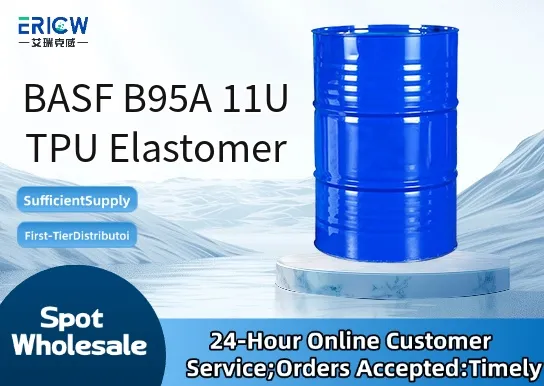
| Chemical Type | Thermoplastic Polyurethane (TPU), Polyester-based |
| Product Form | Pellets |
| Appearance | Translucent, natural-colored pellets |
| Shore Hardness (A) | 95 ± 2 |
| Melt Flow Index (230 °C / 2.16 kg) | 10–14 g/10 min |
| Density (23 °C) | 1.20–1.22 g/cm³ |
| Key Features | Clarity, melt-processability, oil resistance, low-temp flexibility |
| Primary Applications | Extruded films, injection-molded soft-touch parts, medical tubing |
Q1: What is the primary processing method recommended for BASF B95A 11U?
A: BASF B95A 11U is specifically formulated for melt processing via extrusion and injection molding. It exhibits excellent melt stability and low viscosity in the molten state, enabling efficient shaping into flexible profiles, thin-walled parts, and overmolded components.
Q2: Is B95A 11U suitable for applications requiring resistance to hydrolysis and microbial growth?
A: Yes — as an aliphatic polyester-based TPU, B95A 11U offers inherently superior hydrolytic stability compared to aromatic TPUs. Its molecular structure also resists microbial degradation under typical ambient and humid storage conditions, making it well-suited for long-term outdoor or high-moisture-use applications.
Q3: Can B95A 11U be used in direct contact with food or potable water systems?
A: B95A 11U is not pre-approved for food-contact or potable water applications. Customers intending such use must conduct full regulatory evaluation—including compatibility testing and compliance verification with applicable regional frameworks—prior to deployment.
Q4: How does B95A 11U compare to aromatic TPUs in terms of UV resistance and color stability?
A: Unlike aromatic TPUs, B95A 11U contains no UV-sensitive chromophores, delivering excellent inherent UV resistance and outstanding long-term color retention — especially important for transparent or light-colored outdoor products where yellowing must be avoided.
Contact With Us:
E-mail: wangxingqiang@ericwchem.com
Have a Questions? Call Us:
Add:
Building A1, Jiete Industrial Park, Huangpu District, Guangzhou City, Guangdong Province, China