English
 Español
 tiếng việt
 русский
Excellent resistance to high temperatures up to 230 °C short-term and continuous service up to 200 °C.
Superior resistance to aggressive automotive fluids, including modern low-SAPS engine oils and biofuels.
Outstanding compression set resistance, ensuring long-term sealing performance under dynamic and static conditions.
Good processability on standard rubber processing equipment, enabling efficient extrusion and molding.
Low gas permeability, enhancing reliability in vacuum and high-pressure fluid systems.
Automotive fuel system seals and gaskets for gasoline, diesel, and alternative fuel vehicles.
Under-hood engine components, including turbocharger hoses, valve stem seals, and oil cooler O-rings.
Aerospace fluid handling seals exposed to jet fuels, hydraulic fluids, and high-temperature environments.
Industrial pump diaphragms and valve seats operating with aggressive solvents and lubricants.
Oil and gas downhole elastomeric parts requiring stability in sour (H₂S-containing) and high-pressure/temperature conditions.
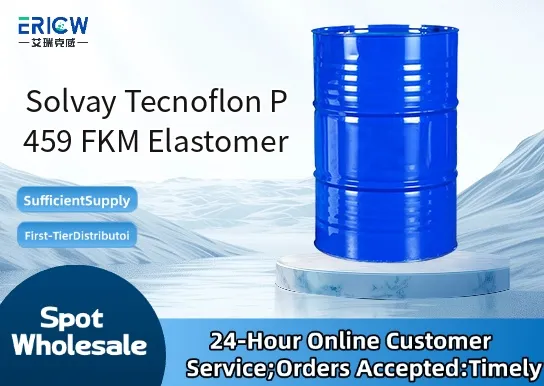
| Chemical Type | Fluoroelastomer (FKM), vinylidene fluoride–hexafluoropropylene–tetrafluoroethylene terpolymer |
| Product Form | Uncured gum stock, pelletized |
| Appearance | Light tan to beige pellets |
| Primary Applications | High-performance static and dynamic seals in automotive, aerospace, and industrial fluid systems |
| Key Features | High-temperature stability, broad chemical resistance, low compression set |
| Benefits | Extended service life, reduced maintenance, compliance with stringent OEM specifications |
| Curing System Compatibility | Conventional bisphenol or peroxide curatives |
| Density (ASTM D297) | ~1.85 g/cm³ |
Q1: What distinguishes Tecnoflon P 459 from other FKM elastomers in terms of processing and final part performance?
A: Tecnoflon P 459 is a peroxide-curable, low-viscosity FKM grade designed for excellent processability—particularly in high-precision injection molding and extrusion—while delivering superior resistance to aggressive chemicals, high temperatures, and compression set compared to standard bisphenol-cured FKMs.
Q2: Is Tecnoflon P 459 suitable for applications requiring resistance to polar solvents and automotive fluids?
A: Yes—Tecnoflon P 459 exhibits outstanding resistance to a broad range of automotive fluids (including modern engine oils, transmission fluids, and brake fluids), as well as polar solvents such as ketones, esters, and chlorinated hydrocarbons, making it well-suited for demanding under-hood and fuel system components.
Q3: How does the peroxide cure system of Tecnoflon P 459 affect its thermal stability and long-term aging behavior?
A: The peroxide-cured network provides enhanced thermal stability and reduced compression set at elevated temperatures, supporting reliable performance in continuous service up to approximately 200 °C and intermittent exposure beyond that—especially in static sealing applications where dimensional stability over time is critical.
Q4: Can Tecnoflon P 459 be compounded with common fillers and processing aids without compromising its key performance attributes?
A: Yes—Tecnoflon P 459 is formulated for compatibility with standard FKM compounding ingredients, including reinforcing fillers (e.g., carbon black and silica), acid acceptors, and processing aids. Optimization of the compound formulation is recommended to balance scorch safety, cure rate, and final physical properties for specific manufacturing conditions.
Contact With Us:
E-mail: wangxingqiang@ericwchem.com
Have a Questions? Call Us:
Add:
Building A1, Jiete Industrial Park, Huangpu District, Guangzhou City, Guangdong Province, China