English
 Español
 tiếng việt
 русский
Excellent abrasion resistance for extended service life in demanding mechanical environments.
High tensile strength and elongation at break, enabling superior elasticity and recovery performance.
Good oil, grease, and solvent resistance suitable for industrial fluid-contact applications.
Outstanding low-temperature flexibility down to –40 °C without significant stiffening.
Processable via standard thermoplastic methods including extrusion, injection molding, and calendering.
Industrial hoses and tubing for pneumatic and hydraulic systems.
Wear-resistant conveyor belts and scraper blades.
Seals, gaskets, and dynamic sealing components.
Roller coverings and precision rollers for printing and paper handling equipment.
Protective coatings and flexible linings for material handling equipment.
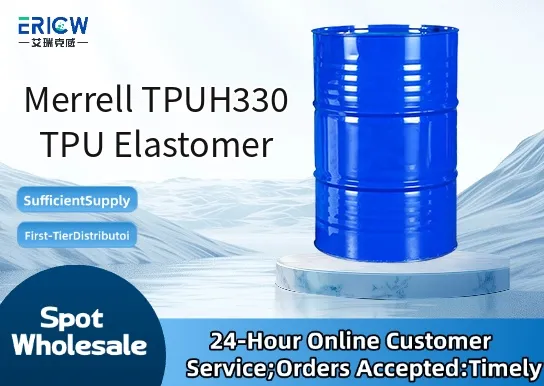
| Chemical Type | Thermoplastic Polyurethane (TPU), Polyester-based |
| Product Form | Pellets |
| Appearance | Off-white to light amber, free-flowing granules |
| Density (g/cm³) | 1.18–1.20 |
| Hardness (Shore A) | 85–90 |
| Melt Flow Index (g/10 min, 210 °C/10 kg) | 15–25 |
| Tensile Strength (MPa) | 35–42 |
| Elongation at Break (%) | 450–550 |
Q1: What are the key processing methods suitable for Merrell TPUH330?
A: Merrell TPUH330 is designed for melt-processing techniques including extrusion, injection molding, and calendering. It exhibits good melt stability and low viscosity at typical processing temperatures, enabling consistent flow and minimal thermal degradation during standard thermoplastic elastomer processing cycles.
Q2: How does Merrell TPUH330 compare to conventional polyester- or polyether-based TPUs in terms of hydrolytic stability?
A: As a polyhydroxybutyrate-modified TPU, Merrell TPUH330 offers enhanced resistance to hydrolysis compared to standard polyester TPUs—particularly under warm, humid conditions—while maintaining better low-temperature flexibility than many polyether variants. Its balanced backbone chemistry supports extended service life in moisture-prone applications without requiring additional stabilizers.
Q3: Is Merrell TPUH330 compatible with common polymer blends such as PVC, ABS, or polyolefins?
A: Merrell TPUH330 demonstrates good compatibility with polar polymers like PVC and ABS, often serving as a toughening modifier or impact enhancer. With non-polar polyolefins (e.g., PP, PE), compatibility is limited without compatibilizers or functionalized coupling agents; formulation trials are recommended to assess phase morphology and mechanical performance.
Q4: Can Merrell TPUH330 be used in applications requiring skin contact or medical device components?
A: Merrell TPUH330 is not pre-certified for biomedical or implantable use. While it meets general requirements for low extractables and complies with standard food-contact-relevant manufacturing practices, regulatory qualification for skin-contact or medical devices must be conducted by the end-user according to applicable regional standards and intended application conditions.
Contact With Us:
E-mail: wangxingqiang@ericwchem.com
Have a Questions? Call Us:
Add:
Building A1, Jiete Industrial Park, Huangpu District, Guangzhou City, Guangdong Province, China