English
 Español
 tiếng việt
 русский
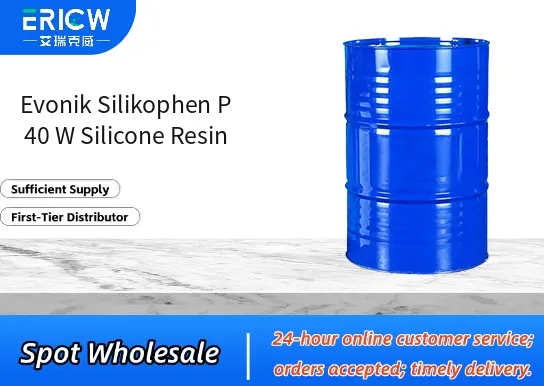
High thermal stability up to 250 °C continuous service temperature.
Excellent weather resistance and UV stability for long-term outdoor performance.
Good compatibility with organic resins and pigments, enabling hybrid formulation design.
Water-white appearance and low volatility, supporting high-clarity coating systems.
Self-crosslinking capability under heat or catalytic conditions, reducing need for external curing agents.
Heat-resistant coatings for industrial exhaust systems and engine components.
Weatherproof topcoats for architectural metal façades and cladding panels.
Binders in silicone-modified intumescent fire-protection coatings.
Matrix resin for high-performance glass-fiber reinforced composites in demanding environments.
| Chemical Type | Phenyl-methyl silicone resin |
| Product Form | Liquid, solvent-based (xylene/isopropanol blend) |
| Appearance | Clear, water-white liquid |
| Solids Content | Approx. 40 wt-% |
| Viscosity (25 °C, DIN 53019) | 800–1200 mPa·s |
| Density (20 °C) | 0.92–0.96 g/cm³ |
| VOC Content | ≈ 600 g/L |
| Primary Applications | High-temperature coatings, weather-resistant topcoats, hybrid binder systems |
Q1: What is the primary function of Silikophen P 40 W in coating formulations?
A: Silikophen P 40 W is a water-based silicone resin designed to enhance surface properties in architectural and industrial coatings—particularly improving water repellency, weather resistance, and substrate compatibility without compromising film integrity or adhesion.
Q2: Can Silikophen P 40 W be used in both solvent-based and water-based systems?
A: It is specifically formulated as a stable aqueous dispersion and is optimized for incorporation into water-based systems. While limited compatibility with low-VOC solvent blends may be achievable under controlled conditions, it is not recommended for fully solvent-based formulations without prior compatibility testing.
Q3: How should Silikophen P 40 W be incorporated into a formulation?
A: It is typically added during the let-down stage under gentle agitation to avoid excessive shear or foaming. Pre-dilution with water or compatible co-solvents may aid uniform dispersion, especially in high-solids or viscous systems.
Q4: Does this product contribute to film hardness or scratch resistance?
A: Yes—its reactive silanol groups can participate in crosslinking within the binder matrix, supporting improved surface hardness, mar resistance, and long-term durability, particularly when thermally cured or co-reacted with suitable crosslinkers.
Contact With Us:
E-mail: wangxingqiang@ericwchem.com
Have a Questions? Call Us:
Add:
Building A1, Jiete Industrial Park, Huangpu District, Guangzhou City, Guangdong Province, China