English
 Español
 tiếng việt
 русский
High chroma and exceptional bluish-red shade purity ideal for demanding color matching.
Outstanding lightfastness and weather resistance, meeting stringent automotive and industrial coating requirements.
Excellent thermal stability up to 220 °C, suitable for high-temperature processing including engineering plastics.
Good dispersibility in both polar and non-polar media, enabling efficient incorporation into paints, inks, and plastics.
Low migration tendency and excellent blooming resistance in PVC and polyolefin applications.
Automotive basecoat and clearcoat systems requiring high durability and gloss retention.
Industrial coil coatings and can coatings where UV resistance and chemical stability are critical.
Engineering thermoplastics including ABS, PS, and PC for exterior automotive and consumer electronics components.
High-performance solvent-based and water-based decorative paints for architectural and OEM applications.
Packaging inks for food-contact-compliant flexible laminates and rigid containers.
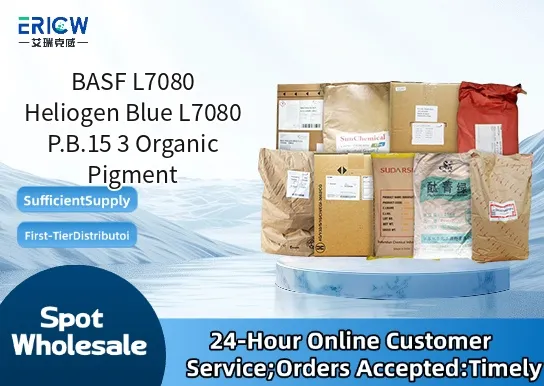
| Chemical Type | Phthalocyanine-based organic pigment (Pigment Blue 15:3) |
| Product Form | Free-flowing powder |
| Appearance | Deep blue crystalline powder |
| Primary Applications | Automotive coatings, engineering plastics, industrial paints, packaging inks |
| Key Features | High lightfastness (ISO 105-B02: 7–8), excellent heat stability, low volatility |
| Benefits | Consistent shade reproducibility, low dust generation, REACH-compliant formulation |
| Regulatory Status | EU REACH registered; compliant with FDA 21 CFR §178.3297 for indirect food contact |
| Recommended Dispersants | High-molecular-weight acrylic or polymeric dispersants |
Q1: What is the primary chemical class and pigment classification of L7080?
A: BASF L7080 is a high-performance copper phthalocyanine-based organic pigment, classified under Colour Index Pigment Blue 15:3 (P.B.15:3), known for its excellent crystalline stability, strong greenish-blue shade, and superior lightfastness.
Q2: Is L7080 suitable for use in automotive coatings and industrial finishes?
A: Yes — L7080 is widely used in demanding automotive OEM and refinish applications due to its outstanding weather resistance, thermal stability up to typical curing temperatures, and compatibility with common acrylic, polyester, and polyurethane resin systems.
Q3: How does L7080 compare to other P.B.15 variants in terms of dispersion behavior and gloss performance?
A: As a beta-phase P.B.15:3 pigment, L7080 offers improved dispersibility in both solvent-borne and high-solids systems compared to alpha-phase variants, enabling higher gloss retention and more uniform color development in clearcoats and metallic basecoats.
Q4: Can L7080 be used in waterborne coating systems?
A: Yes — L7080 is compatible with modern waterborne acrylic and hybrid resin systems when properly dispersed using appropriate surfactants or polymeric dispersants; formulation optimization is recommended to ensure colloidal stability and optimal color strength.
Q5: What is the typical dosage range for L7080 in industrial coating formulations?
A: Dosage depends on the required color strength and opacity, but L7080 is typically used at low concentrations — generally ranging from 0.1% to 2% by weight in finished coating systems — leveraging its high tinctorial strength and efficient pigment utilization.
Contact With Us:
E-mail: wangxingqiang@ericwchem.com
Have a Questions? Call Us:
Add:
Building A1, Jiete Industrial Park, Huangpu District, Guangzhou City, Guangdong Province, China