English
 Español
 tiếng việt
 русский
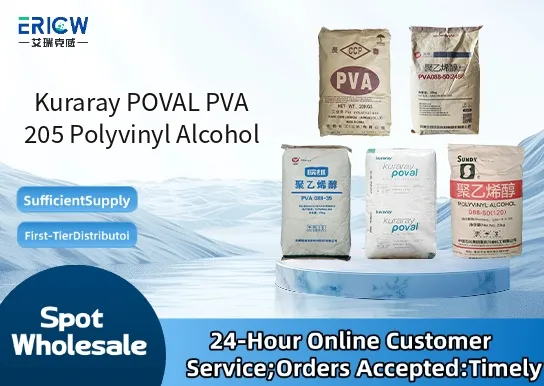
High water solubility with rapid dissolution in cold and warm water.
Excellent film-forming capability yielding strong, flexible, and transparent films.
Superior adhesion to polar substrates including paper, wood, and metal surfaces.
Low residual acetyl content ensuring high hydrophilicity and biodegradability.
Consistent batch-to-batch quality supported by Kuraray’s stringent GMP-compliant manufacturing.
Water-soluble packaging films for detergent pods and agrochemical encapsulation.
Binders in ceramic and refractory green bodies for improved dry strength and burnout performance.
Thickener and stabilizer in aqueous pigment dispersions for textile printing pastes.
Protective colloid in emulsion polymerization of vinyl acetate and acrylic monomers.
Base polymer for specialty adhesives used in labeling, laminating, and corrugated board manufacturing.
| Chemical Type | Polyvinyl alcohol (fully hydrolyzed) |
| Product Form | White granular powder |
| Appearance | Free-flowing, odorless granules |
| Saponification Degree | ≥ 98.0 mol% |
| Viscosity (4% aqueous solution at 20°C) | 20–23 mPa·s |
| Residual Acetaldehyde Content | ≤ 0.1 wt% |
| pH (1% aqueous solution) | 5.0–7.0 |
| Moisture Content | ≤ 5.0 wt% |
Q1: What is the primary functional role of POVAL PVA 205 in water-based formulations?
A: POVAL PVA 205 functions primarily as a film-forming binder and rheology modifier in aqueous systems. Its partial hydrolysis degree provides balanced water solubility and cohesive strength, making it especially effective in coatings, adhesives, and textile sizing where controlled viscosity and good substrate adhesion are required.
Q2: How does POVAL PVA 205 compare to fully hydrolyzed PVA grades in terms of solubility and film properties?
A: Compared to fully hydrolyzed PVAs, POVAL PVA 205 offers faster dissolution in cold water and improved flexibility in dry films due to its lower degree of hydrolysis. It also exhibits reduced brittleness and enhanced compatibility with hydrophobic additives, though it may show slightly lower moisture resistance in high-humidity environments.
Q3: Is POVAL PVA 205 suitable for use in food-contact or pharmaceutical applications?
A: POVAL PVA 205 is manufactured under stringent quality control and is commonly used in applications requiring high purity, including certain pharmaceutical excipients and food packaging coatings. However, final regulatory compliance depends on the complete formulation, processing conditions, and applicable regional requirements — users must verify suitability through their own qualification and regulatory assessment.
Q4: What are typical handling considerations when dissolving POVAL PVA 205?
A: For optimal dissolution, gradually disperse the powder into cold water under moderate agitation to prevent agglomeration. A brief heating step (typically up to 80–90 °C) may be applied after initial wetting to ensure complete solubilization. Avoid prolonged high-shear mixing at elevated temperatures, as this may reduce molecular integrity and solution viscosity.
Contact With Us:
E-mail: wangxingqiang@ericwchem.com
Have a Questions? Call Us:
Add:
Building A1, Jiete Industrial Park, Huangpu District, Guangzhou City, Guangdong Province, China