English
 Español
 tiếng việt
 русский
Broad-spectrum control against key fungal pathogens including Botrytis, Sclerotinia, and Monilinia species.
Systemic and translaminar activity ensures reliable protection and curative action on new growth.
Low application rates supported by high intrinsic efficacy and favorable environmental profile.
Compatible with integrated pest management (IPM) programs and beneficial insect conservation.
Flexible timing — effective as both preventive and early curative treatment in multiple crops.
Fruit orchards (e.g., apple, pear, stone fruit) for control of blossom blight and fruit rot.
Vineyards targeting Botrytis cinerea (gray mold) during flowering and pre-harvest stages.
Strawberry production systems managing anthracnose and gray mold under protected and open-field conditions.
Leafy vegetables and brassicas where post-harvest fungal decay is a critical quality concern.
| Chemical Type | Carboxamide fungicide (active ingredient: fluopyram) |
| Product Form | Flowable concentrate (SC) |
| Appearance | Off-white to light tan suspension |
| Primary Applications | Fruit, vegetables, vines, and ornamentals |
| Key Features | Multi-site + single-site mode of action; resistance management tool |
| Benefits | Extended residual activity, rainfastness within 2 hours, low volatility |
| REI (Re-Entry Interval) | 12 hours (as per label guidelines) |
| PHI (Pre-Harvest Interval) | Crop-specific; ranges from 0–7 days depending on use pattern |
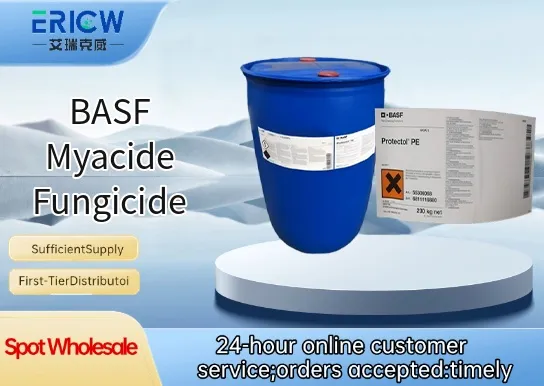
Q1: What types of fungi does BASF Myacide Fungicide control?
A: BASF Myacide Fungicide is effective against a broad spectrum of common spoilage and pathogenic fungi, including Aspergillus, Penicillium, Cladosporium, and yeasts such as Candida and Rhodotorula. Its activity is particularly relevant in non-sterile, water-based industrial systems where microbial growth poses stability or quality risks.
Q2: In which industrial applications is Myacide Fungicide typically used?
A: It is widely applied in water-miscible metalworking fluids, latex paints and coatings, adhesives, construction chemicals, and other aqueous formulations requiring long-term fungal protection during storage and use. It is not intended for food-contact surface disinfection or agricultural crop protection.
Q3: How should Myacide Fungicide be incorporated into a formulation?
A: Myacide Fungicide is fully miscible in water and many polar organic solvents. It is generally added during the final stage of formulation under mild agitation to ensure uniform distribution. Compatibility with other biocides and formulation ingredients should be verified through stability and efficacy testing prior to full-scale implementation.
Q4: Is Myacide Fungicide compatible with common preservative systems?
A: Yes — Myacide Fungicide is frequently used in combination with isothiazolinones or formaldehyde donors to provide synergistic broad-spectrum preservation. However, compatibility must be assessed on a case-by-case basis, especially in complex matrices containing surfactants, thickeners, or high electrolyte content.
Contact With Us:
E-mail: wangxingqiang@ericwchem.com
Have a Questions? Call Us:
Add:
Building A1, Jiete Industrial Park, Huangpu District, Guangzhou City, Guangdong Province, China