English
 Español
 tiếng việt
 русский
High-gloss, durable film formation for premium aesthetic performance.
Excellent compatibility with common crosslinkers including melamine and polyisocyanates.
Good hydrolytic stability and resistance to yellowing under UV exposure.
Low VOC formulation suitable for compliance with stringent environmental regulations.
Consistent batch-to-batch reproducibility and robust rheological behavior in solvent-based systems.
Automotive topcoats and clearcoats requiring high clarity and long-term weatherability.
Industrial maintenance coatings for metal substrates exposed to outdoor conditions.
General-purpose coil coatings demanding excellent formability and corrosion resistance.
Refinish coatings where color fidelity and gloss retention are critical.
| Chemical Type | Acrylic copolymer |
| Product Form | Solution in aromatic hydrocarbons (e.g., xylene, Solvesso™) |
| Appearance | Clear, colorless to pale yellow liquid |
| Non-Volatile Content (wt%) | 50 ± 2% |
| Acid Value (mg KOH/g) | 8–12 |
| Weight-Average Molecular Weight (Mw) | ~10,000–15,000 g/mol |
| Viscosity (25°C, mPa·s) | 1,200–1,800 (measured at 60% solids in xylene) |
| Primary Applications | High-performance solventborne automotive and industrial coatings |
Q1: What is the primary function of ACROPOL 63-893 in coating formulations?
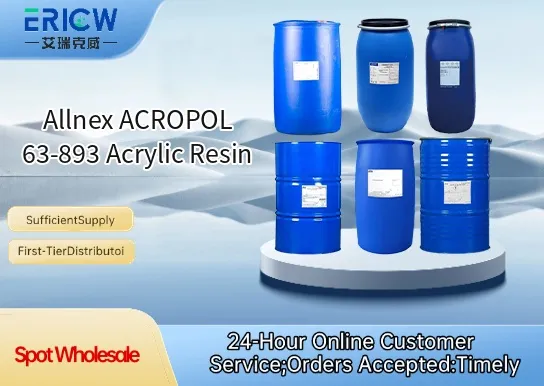
A: ACROPOL 63-893 is a specialty acrylic resin designed to act as a rheology modifier and matting agent, providing controlled viscosity development and contributing to uniform surface texture and reduced gloss in solventborne and high-solids industrial coatings.
Q2: Is ACROPOL 63-893 compatible with common crosslinkers used in thermosetting acrylic systems?
A: Yes, it demonstrates good compatibility with standard amino resins (e.g., melamine-formaldehyde) and isothiocyanate-based crosslinkers, supporting robust cure response and film integrity in baked industrial finishes.
Q3: How should ACROPOL 63-893 be incorporated into a formulation to ensure optimal dispersion and performance?
A: It is recommended to add ACROPOL 63-893 during the let-down stage under moderate agitation, followed by sufficient dispersion time to achieve full wetting and stabilization. Pre-dilution in a compatible solvent may improve handling in high-viscosity systems.
Q4: Can ACROPOL 63-893 be used in low-VOC or high-solids applications?
A: Yes, its molecular design supports use in high-solids formulations where reduced solvent content is required, and it contributes to stable rheology without compromising application properties such as flow, leveling, or sag resistance.
Contact With Us:
E-mail: wangxingqiang@ericwchem.com
Have a Questions? Call Us:
Add:
Building A1, Jiete Industrial Park, Huangpu District, Guangzhou City, Guangdong Province, China