English
 Español
 tiếng việt
 русский
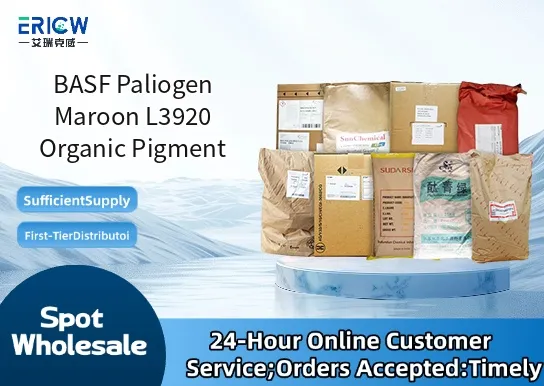
High thermal stability suitable for processing temperatures up to 280 °C.
Excellent lightfastness and weather resistance (ISO 105-B02, Grade 7–8).
Outstanding chemical resistance to acids, alkalis, and solvents.
Strong tinting strength and high chroma in maroon shade with neutral undertone.
Good dispersibility in both solvent-based and water-based systems.
Automotive coatings (OEM and refinish).
Industrial coil and can coatings.
Plastic coloration (polyolefins, engineering plastics, PVC).
High-performance inks for packaging and security printing.
Architectural and decorative paints requiring long-term durability.
| Chemical Type | Perylene derivative |
| Product Form | Free-flowing powder |
| Appearance | Maroon to reddish-brown fine powder |
| Primary Applications | Coatings, plastics, inks |
| Key Features | Thermal stability, lightfastness, chemical resistance |
| Benefits | Color consistency, low migration, excellent dispersion |
| Particle Size (D50) | Approx. 0.12–0.18 µm |
| Specific Surface Area | 45–55 m²/g |
Q1: What are the key performance advantages of Paliogen Maroon L3920 compared to conventional maroon pigments?
A: Paliogen Maroon L3920 offers superior thermal stability and lightfastness, making it particularly suitable for high-temperature processing applications such as engineering plastics compounding. Its robust molecular structure also delivers excellent resistance to migration and blooming in demanding polymer systems.
Q2: Is Paliogen Maroon L3920 suitable for use in food-contact plastics?
A: Paliogen Maroon L3920 is not certified for direct food-contact applications under major regulatory frameworks. It is intended for non-food-contact industrial uses, including automotive components, construction materials, and technical masterbatches where regulatory compliance for food contact is not required.
Q3: Which polymer systems show optimal dispersion and color development with this pigment?
A: Paliogen Maroon L3920 demonstrates excellent dispersibility and color strength in polyolefins (PP, PE), polyesters (PET, PBT), and engineering thermoplastics such as PA6 and PC. Performance may vary in polar or highly crystalline matrices, so pre-dispersion testing is recommended for new formulations.
Q4: How should Paliogen Maroon L3920 be handled during processing to maintain its performance?
A: To preserve thermal stability and minimize degradation, avoid prolonged residence times above 300 °C during extrusion or injection molding. Use standard pigment handling precautions—store in a cool, dry place away from direct sunlight and moisture—and ensure adequate ventilation during dry blending or feeding operations.
Contact With Us:
E-mail: wangxingqiang@ericwchem.com
Have a Questions? Call Us:
Add:
Building A1, Jiete Industrial Park, Huangpu District, Guangzhou City, Guangdong Province, China