English
 Español
 tiếng việt
 русский
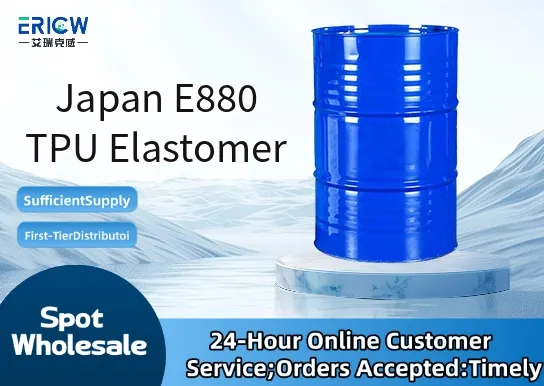
Exceptional abrasion resistance for extended service life in high-wear environments.
Outstanding low-temperature flexibility down to –40 °C without embrittlement.
Excellent oil, grease, and hydrocarbon resistance suitable for demanding industrial conditions.
High tensile strength and elongation at break, enabling reliable performance under dynamic stress.
Good processability via extrusion, injection molding, and calendering with minimal thermal degradation.
Automotive interior trim components including instrument panel skins and door panels.
Industrial hoses and fluid transfer tubing requiring chemical resilience and kink resistance.
High-performance footwear midsoles and outsoles demanding rebound and durability.
Roller covers and precision rollers for printing, paper handling, and coating equipment.
Medical-grade tubing and non-implantable device housings compliant with ISO 10993-5 cytotoxicity screening.
| Chemical Type | Thermoplastic Polyurethane (TPU), Polyester-based |
| Product Form | Natural granules, free-flowing pellets |
| Appearance | Opaque off-white to light beige, uniform particle size |
| Primary Applications | Extrusion, injection molding, calendering |
| Key Features | Abrasion resistance, low-temperature flexibility, oil resistance |
| Processing Temperature Range | 180–220 °C (barrel); 20–60 °C (mold) |
| Density (ASTM D792) | 1.20–1.22 g/cm³ |
| Melt Flow Index (ASTM D1238, 235 °C/2.16 kg) | 10–14 g/10 min |
Q1: What is the primary application profile of Japan E880 TPU Elastomer?
A: Japan E880 is a thermoplastic polyurethane elastomer engineered for high-performance flexible applications requiring excellent abrasion resistance, elasticity, and clarity—commonly used in premium medical tubing, soft-touch overmolding, thin-walled extrusions, and precision injection-molded components where consistent melt flow and low compression set are critical.
Q2: Is Japan E880 suitable for medical or food-contact applications?
A: Japan E880 is formulated to meet general regulatory expectations for biocompatibility and extractables control. While it is widely selected for Class II medical devices and food-grade packaging components, final compliance depends on full system validation—including processing conditions, additives, and end-use requirements—so users should conduct appropriate testing and consult regulatory documentation for their specific application.
Q3: How does Japan E880 compare to conventional aromatic TPUs in terms of yellowing resistance?
A: As a non-yellowing aliphatic TPU, Japan E880 offers significantly improved UV and thermal stability compared to aromatic grades. It maintains optical clarity and color fidelity during prolonged exposure to light and elevated temperatures—making it preferred for transparent or light-colored applications where aesthetic stability is essential.
Q4: What drying and processing recommendations apply to Japan E880?
A: Like most hygroscopic TPUs, Japan E880 requires thorough pre-drying prior to processing—typically at 70–80 °C for 3–4 hours using desiccant drying—to minimize moisture-induced degradation and surface defects. Melt processing temperatures generally range between 180–220 °C, with mold temperatures optimized between 20–40 °C depending on part geometry and performance targets.
Contact With Us:
E-mail: wangxingqiang@ericwchem.com
Have a Questions? Call Us:
Add:
Building A1, Jiete Industrial Park, Huangpu District, Guangzhou City, Guangdong Province, China