English
 Español
 tiếng việt
 русский
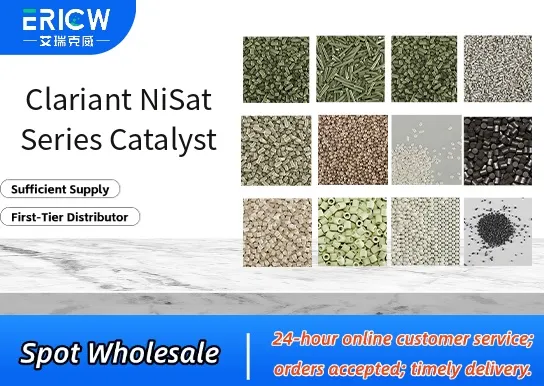
Highly selective nickel-based catalyst system optimized for saturated hydrocarbon feedstocks.
Thermally stable formulation enabling robust performance under extended operation at elevated temperatures.
Low dust generation and excellent mechanical strength for reduced attrition in fixed-bed and trickle-bed reactors.
Tailored pore structure facilitating efficient mass transfer and minimizing coking tendencies.
Consistent batch-to-batch reproducibility supported by Clariant’s ISO 9001-certified manufacturing control.
Hydrogenation of aromatic compounds in fine chemical synthesis.
Selective saturation of alkenes and alkynes in pharmaceutical intermediate manufacturing.
Deoxygenation of bio-derived feedstocks in renewable fuel upgrading.
Purification of polymer-grade monomers via trace impurity removal.
Nitro-group reduction in agrochemical active ingredient production.
| Chemical Type | Nickel on high-surface-area alumina support |
| Product Form | Extrudates (cylindrical pellets) |
| Appearance | Gray to black free-flowing granules |
| Primary Applications | Low-pressure hydrogenation, saturation, and purification reactions |
| Key Features | High nickel dispersion, controlled acidity, low sulfur sensitivity |
| Benefits | Extended catalyst life, minimal metal leaching, compatibility with continuous processing |
| Storage Conditions | Store in dry, inert atmosphere; avoid exposure to moisture and air |
| Handling Precautions | Use in well-ventilated area; avoid inhalation of dust; refer to SDS for safety protocols |
Q1: What is the primary function of the Clariant NiSat Series Catalyst in polymer processing?
A: The NiSat Series is a nickel-based catalyst system designed to promote efficient crosslinking and saturation reactions—particularly in thermoplastic elastomers, polyolefin blends, and specialty polymer compounds where controlled reactivity and thermal stability are required.
Q2: How does the NiSat Series differ from conventional cobalt or manganese catalysts?
A: Unlike cobalt- or manganese-based alternatives, NiSat catalysts offer enhanced selectivity in hydrogenation and crosslinking steps, reduced risk of over-catalysis, and improved compatibility with heat-sensitive polymers—making them especially suitable for applications requiring precise reaction control and minimal color formation.
Q3: Is the NiSat Series compatible with peroxide-initiated curing systems?
A: Yes—the NiSat Series is formulated to be compatible with common peroxide initiators and can be used synergistically to improve cure efficiency and network uniformity, particularly in EPDM, silicone, and halogen-free flame-retardant compounds.
Q4: What handling precautions should be observed during storage and processing?
A: As with other transition-metal catalysts, NiSat products should be stored under inert atmosphere or sealed packaging to prevent moisture uptake and oxidation. Processing temperatures should remain within recommended limits for the specific grade to maintain catalytic integrity and avoid premature decomposition.
Contact With Us:
E-mail: wangxingqiang@ericwchem.com
Have a Questions? Call Us:
Add:
Building A1, Jiete Industrial Park, Huangpu District, Guangzhou City, Guangdong Province, China