English
 Español
 tiếng việt
 русский
Excellent low-temperature flexibility with a glass transition temperature (Tg) of approximately −55 °C.
Outstanding resistance to ozone, UV radiation, and weathering without requiring additional stabilizers.
Good melt processability for extrusion, injection molding, and blow molding operations.
High elasticity and reversible deformation recovery under repeated stress cycles.
Compatible with polyolefins and suitable for dynamic vulcanization in thermoplastic vulcanizates (TPVs).
Automotive interior trim components requiring soft-touch feel and long-term durability.
Seals and gaskets for HVAC systems exposed to thermal cycling and environmental aging.
Flexible overmolding on PP and PE substrates for consumer electronics housings.
Medical tubing and fluid-handling components where extractables and biocompatibility are critical.
Soft-grip handles for power tools and industrial equipment requiring ergonomic performance.
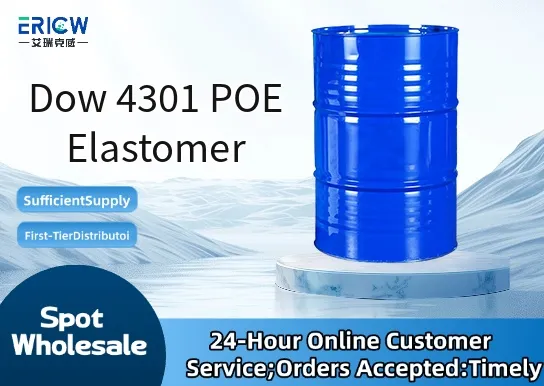
| Chemical Type | Polyolefin Elastomer (POE), ethylene-octene copolymer |
| Product Form | Natural-colored pellets |
| Appearance | Opaque, free-flowing cylindrical pellets |
| Primary Applications | Thermoplastic elastomer compounds, soft-touch overmolding, flexible seals |
| Key Features | Low density, high resilience, excellent clarity in thin sections |
| Benefits | Reduced energy consumption during processing, extended service life in outdoor applications |
| Processing Method | Extrusion, injection molding, blow molding |
| Regulatory Compliance | Meets FDA 21 CFR §177.1520 for food-contact applications (subject to formulation) |
Q1: What is the primary function of Dow 4301 POE Elastomer in polymer blends?
A: Dow 4301 POE Elastomer is primarily used as a toughening agent and impact modifier in polyolefin-based systems, enhancing flexibility, elongation at break, and low-temperature performance without significantly compromising stiffness or processability.
Q2: Is Dow 4301 compatible with polypropylene (PP) and polyethylene (PE) matrices?
A: Yes — Dow 4301 is specifically designed for compatibility with both homopolymer and copolymer polypropylene, as well as various grades of polyethylene including HDPE and LLDPE. Its ethylene-octene backbone provides favorable interfacial adhesion and dispersion in these non-polar resins.
Q3: How does Dow 4301 differ from conventional EPDM or EPR elastomers in processing behavior?
A: Unlike traditional diene-based elastomers, Dow 4301 offers superior melt flow consistency, narrower molecular weight distribution, and lower viscosity — enabling easier extrusion, injection molding, and improved dispersion at typical processing temperatures for polyolefins.
Q4: Can Dow 4301 be used in applications requiring FDA-compliant food contact materials?
A: Dow 4301 is manufactured under controlled conditions suitable for indirect food contact applications where permitted by regulatory frameworks. Final compliance depends on full formulation, processing conditions, and end-use requirements — users should conduct appropriate regulatory assessments and consult Dow’s regulatory documentation for intended use cases.
Contact With Us:
E-mail: wangxingqiang@ericwchem.com
Have a Questions? Call Us:
Add:
Building A1, Jiete Industrial Park, Huangpu District, Guangzhou City, Guangdong Province, China