English
 Español
 tiếng việt
 русский
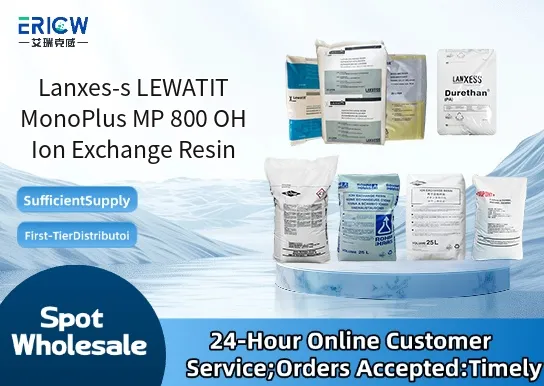
Highly uniform spherical beads ensuring consistent hydraulic performance and low pressure drop.
Superior chemical and osmotic stability, especially in repeated regeneration cycles with caustic soda.
Optimized macroporous matrix structure for enhanced kinetics and efficient removal of weakly ionized species.
Low total organic carbon (TOC) extractables, meeting stringent requirements for pharmaceutical and ultrapure water applications.
Regenerable to full capacity using standard NaOH solutions, supporting sustainable operation and reduced waste generation.
Final polishing step in ultrapure water (UPW) systems for semiconductor manufacturing.
Dealkalization and silica removal in power plant boiler feedwater pretreatment.
Purification of process water in biopharmaceutical production and API synthesis.
Neutralization and hydroxide form conditioning in mixed-bed demineralization units.
| Chemical Type | Strong base anion exchange resin, Type I, macroporous |
| Product Form | OH⁻ form (hydroxide form) |
| Appearance | Beige to light brown, spherical beads |
| Functional Group | Quaternary ammonium (–N⁺(CH₃)₃) |
| Matrix Structure | Macroporous polystyrene-divinylbenzene copolymer |
| Moisture Content | 45 – 50 % (as shipped) |
| Particle Size Range | 300 – 1200 µm (95 % retained between 300–1200 µm) |
| Uniformity Coefficient | ≤ 1.6 |
Q1: What is the primary functional form of Lanxes-s LEWATIT MonoPlus MP 800 OH resin?
A: This resin is supplied in the hydroxide (OH⁻) form, making it a strong base anion exchange resin optimized for deionization, nitrate removal, and other anion-selective applications in high-purity water systems.
Q2: How does MP 800 OH differ from standard gel-type strong base anion resins?
A: MP 800 OH features a macroporous polystyrene matrix with uniform spherical beads, offering superior physical stability, faster kinetics, and enhanced resistance to organic fouling compared to conventional gel-type resins—especially beneficial in feedwaters with variable quality or low ionic strength.
Q3: Is this resin suitable for pharmaceutical or ultrapure water production?
A: Yes—MP 800 OH is widely used in pharmaceutical water systems (e.g., WFI and PW polishing) and semiconductor-grade UPW applications due to its low extractables profile, high regeneration efficiency, and compliance with relevant pharmacopoeial requirements for ion exchange materials.
Q4: What regeneration chemicals are recommended for this resin?
A: Sodium hydroxide (NaOH) is the standard regenerant. Typical concentrations range from 2% to 4% w/w, with dosage and contact time adjusted based on service cycle length, loading, and desired effluent quality.
Q5: Can MP 800 OH be used in mixed-bed configurations?
A: Yes—it is commonly paired with strong acid cation resins (e.g., LEWATIT S 108 H) in mixed-bed units for final polishing, where its high selectivity for weakly ionized species (e.g., silica, CO₂-derived bicarbonate) supports consistent ultrapure water generation.
Contact With Us:
E-mail: wangxingqiang@ericwchem.com
Have a Questions? Call Us:
Add:
Building A1, Jiete Industrial Park, Huangpu District, Guangzhou City, Guangdong Province, China