English
 Español
 tiếng việt
 русский
Excellent soft-touch feel with Shore A hardness of 35, providing optimal ergonomic comfort for handheld devices.
Outstanding adhesion to polypropylene (PP) and polyethylene (PE) without requiring primers or surface treatment.
Good processability via injection molding and extrusion, with low melt viscosity and fast cycle times.
Enhanced UV resistance and long-term color stability under indoor and controlled outdoor conditions.
RoHS-compliant formulation with no added phthalates, heavy metals, or halogenated flame retardants.
Overmolding for consumer electronics housings, including remote controls, power tools, and kitchen appliances.
Soft-grip components for automotive interior trim, such as gear shift knobs and door handles.
Sealing and gasketing solutions in white goods and HVAC systems requiring flexibility and compression set resistance.
Medical device grips and non-sterile housing overmolds where biocompatibility (ISO 10993-5 cytotoxicity tested) is required.
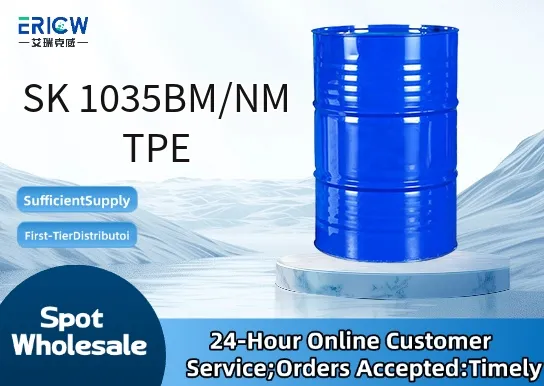
| Chemical Type | Thermoplastic Elastomer (TPE) — Styrenic Block Copolymer (SBC) based |
| Product Form | Natural-colored pellets |
| Appearance | Opaque, uniform granules with minimal fines |
| Shore A Hardness | 35 ± 2 |
| Melt Flow Rate (230°C/2.16 kg) | 18–22 g/10 min |
| Density (23°C) | 0.92–0.94 g/cm³ |
| Key Features | PP/PE adhesion, soft-touch, easy processing, RoHS compliant |
| Primary Applications | Two-shot overmolding, soft-grip components, sealing profiles |
Q1: What is the primary functional role of SK 1035BM/NM TPE in thermoplastic elastomer formulations?
A: SK 1035BM/NM TPE is a specialized processing aid and compatibility enhancer designed to improve melt flow, reduce viscosity, and promote uniform dispersion of fillers or polar additives in TPE blends—particularly in SEBS- or TPU-based systems.
Q2: Is SK 1035BM/NM TPE compatible with common food-contact or medical-grade TPE compounds?
A: While SK 1035BM/NM TPE is formulated for high-purity applications and exhibits low volatility and minimal extractables, formal regulatory compliance (e.g., FDA, EU food-contact status) must be verified per final compound formulation and processing conditions—not by the additive alone.
Q3: How should SK 1035BM/NM TPE be incorporated into a TPE compound during compounding?
A: It is typically added directly to the base polymer during the initial melt-mixing stage, either as pellets or pre-blended masterbatch. Good dispersion is achieved under standard twin-screw extrusion conditions; dosage generally ranges from 0.1% to 2% by weight, depending on formulation complexity and performance targets.
Q4: Does SK 1035BM/NM TPE affect the mechanical properties of the final TPE product?
A: When used within recommended dosage ranges, it maintains or slightly enhances elongation and tensile strength while improving processability. Significant over-addition may reduce hardness or modulus, so optimization is advised for each specific system.
Contact With Us:
E-mail: wangxingqiang@ericwchem.com
Have a Questions? Call Us:
Add:
Building A1, Jiete Industrial Park, Huangpu District, Guangzhou City, Guangdong Province, China