English
 Español
 tiếng việt
 русский
Excellent abrasion resistance for extended service life in demanding mechanical environments.
High tensile strength and elongation at break, enabling robust performance under dynamic loading.
Good low-temperature flexibility down to –30 °C, maintaining elasticity in cold-condition applications.
Outstanding processability via extrusion, injection molding, and calendering with minimal thermal degradation.
Hydrolysis-resistant formulation suitable for humid or wet-service conditions over prolonged exposure.
Industrial hoses and tubing for pneumatic, hydraulic, and material handling systems.
Roller covers and wear components in printing, paper, and converting machinery.
High-performance seals, gaskets, and vibration-damping mounts in automotive and industrial equipment.
Footwear midsoles and outsoles requiring resilience, energy return, and durability.
Conveyor belting and modular belt components for food processing and packaging lines.
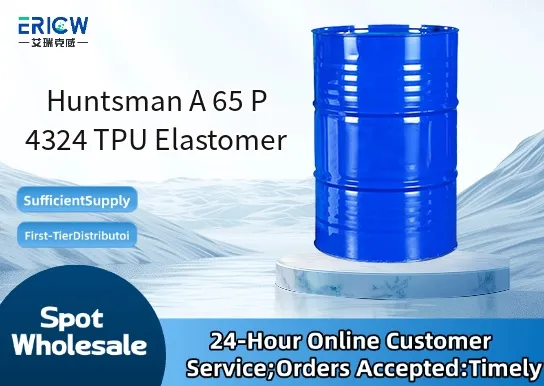
| Chemical Type | Aliphatic polyester-based thermoplastic polyurethane (TPU) |
| Product Form | Pellets |
| Appearance | Off-white to light tan, free-flowing granules |
| Hardness (Shore A) | 65 ± 2 |
| Melt Flow Index (230 °C / 2.16 kg) | 10–14 g/10 min |
| Density | 1.18–1.20 g/cm³ |
| Key Features | Hydrolysis resistance, excellent abrasion resistance, good UV stability |
| Primary Applications | Extruded profiles, molded parts, flexible tubing, industrial wear components |
Q1: What is the primary function of A 65 P 4324 in TPU formulations?
A: A 65 P 4324 is a polyether-based thermoplastic polyurethane elastomer designed to enhance melt processability, improve low-temperature flexibility, and provide balanced mechanical resilience in extruded or injection-molded TPU compounds.
Q2: Is A 65 P 4324 compatible with other TPU grades or polymer blends?
A: Yes — it exhibits good compatibility with a range of aromatic and aliphatic TPU resins, as well as certain engineering thermoplastics like PC and ABS when used in carefully designed alloy systems. Compatibility should always be verified through small-scale rheological and morphological testing.
Q3: What processing methods are recommended for A 65 P 4324?
A: It is optimized for conventional thermoplastic processing techniques including extrusion, injection molding, and blow molding. Pre-drying is strongly recommended prior to processing to maintain hydrolytic stability and achieve consistent mechanical performance.
Q4: How does A 65 P 4324 perform under humid or elevated temperature conditions?
A: As a polyether-based TPU, it offers inherently better resistance to hydrolysis and thermal aging compared to polyester TPUs, making it suitable for applications exposed to moderate humidity and intermittent elevated temperatures during service life.
Contact With Us:
E-mail: wangxingqiang@ericwchem.com
Have a Questions? Call Us:
Add:
Building A1, Jiete Industrial Park, Huangpu District, Guangzhou City, Guangdong Province, China