English
 Español
 tiếng việt
 русский
High thermal stability with continuous service up to 200 °C.
Excellent compatibility with organic resins and vinyl-based polymers.
Low volatility and minimal weight loss under elevated temperature conditions.
Enhanced adhesion promotion in silicone-modified coating systems.
Reactive vinyl groups enable covalent bonding during curing processes.
Heat-resistant silicone coatings for metal substrates.
Modifier for UV-curable hybrid resin formulations.
Release agent component in high-temperature composite molding.
Functional additive in flame-retardant sealants and gaskets.
Base fluid for specialty lubricants in precision instrumentation.
| Chemical Type | Vinylphenylmethyl silicone fluid |
| Product Form | Clear, colorless to pale yellow liquid |
| Appearance | Homogeneous, low-viscosity liquid at 25 °C |
| Primary Applications | Reactive modifier, thermal interface fluid, coating additive |
| Key Features | Vinyl functionality (~0.3–0.5 wt%), phenyl content for thermal resilience |
| Benefits | Improved crosslink density, reduced outgassing, enhanced substrate wetting |
| Storage Stability | Stable for ≥12 months in sealed containers at <30 °C, protected from moisture |
| Handling Precautions | Use in well-ventilated areas; avoid prolonged skin contact |
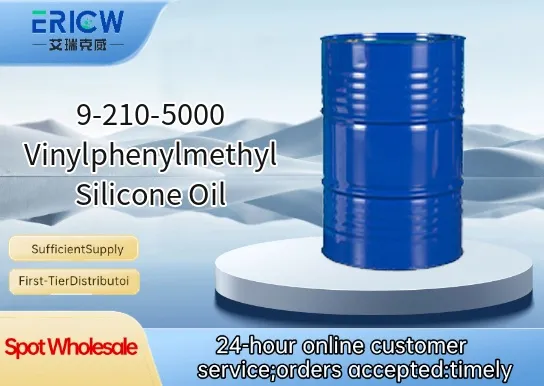
Q1: What is the primary functional role of 9-210-5000 in formulation systems?
A: 9-210-5000 Vinylphenylmethyl Silicone Oil serves primarily as a reactive silicone modifier—its vinyl and phenyl groups enable covalent incorporation into crosslinked polymer networks (e.g., via hydrosilylation), enhancing thermal stability, surface migration resistance, and compatibility with aromatic or high-refractive-index matrices.
Q2: How does this grade differ from standard methylvinylsilicone oils?
A: Unlike conventional methylvinylsilicones, 9-210-5000 incorporates phenyl substituents on the siloxane backbone, which significantly improves refractive index matching, UV stability, and compatibility with styrenic, acrylic, and epoxy resins—making it especially suitable for optical coatings and high-performance elastomer modifiers.
Q3: Is 9-210-5000 compatible with platinum-catalyzed cure systems?
A: Yes—this grade is fully compatible with platinum-based catalysts (e.g., Karstedt’s or Ashby-type complexes) and is commonly used in addition-cure silicones where controlled reactivity and low volatility are required. Its phenyl content does not inhibit catalysis under typical processing conditions.
Q4: What are typical handling and storage recommendations?
A: Store in tightly sealed containers under inert atmosphere (e.g., nitrogen), away from moisture, strong oxidizers, and direct sunlight. Avoid prolonged exposure to elevated temperatures (>60 °C) to preserve vinyl functionality and shelf life. Standard industrial PPE (gloves, eye protection) is recommended during handling.
Q5: Can 9-210-5000 be used in food-contact or pharmaceutical applications?
A: This material is not pre-approved for direct food-contact or pharmaceutical use. Customers intending such applications must conduct full regulatory evaluation—including extractables profiling and compliance verification per applicable regional requirements—prior to implementation.
Contact With Us:
E-mail: wangxingqiang@ericwchem.com
Have a Questions? Call Us:
Add:
Building A1, Jiete Industrial Park, Huangpu District, Guangzhou City, Guangdong Province, China