English
 Español
 tiếng việt
 русский
High-solids, low-viscosity formulation enables efficient processing and reduced VOC emissions.
Excellent compatibility with standard styrene monomers and common polyester additives.
Superior mechanical strength and dimensional stability in cured laminates.
Consistent reactivity profile ensures reliable gel time control in ambient and elevated temperature curing.
Formulated for enhanced weatherability and long-term UV resistance in exterior applications.
Fiberglass-reinforced plastic (FRP) panels for architectural cladding and façades.
Marine deck and hull components requiring corrosion resistance and impact durability.
Transportation interior parts including bus and rail ceiling panels and wall liners.
Industrial tanks and secondary containment systems for chemical storage.
Custom composite enclosures for electrical and telecom infrastructure.
| Chemical Type | Unsaturated orthophthalic polyester resin |
| Product Form | Liquid |
| Appearance | Clear to pale yellow, homogeneous liquid |
| Primary Applications | FRP laminating, spray-up, and compression molding |
| Key Features | High solids content (~65–70%), low styrene demand, good thixotropy |
| Benefits | Improved worker safety (lower VOC), faster cycle times, excellent surface finish |
| Recommended Catalyst | Methyl ethyl ketone peroxide (MEKP) at 1.0–1.5% w/w |
| Storage Stability | 6 months minimum at <25°C in sealed, original container |
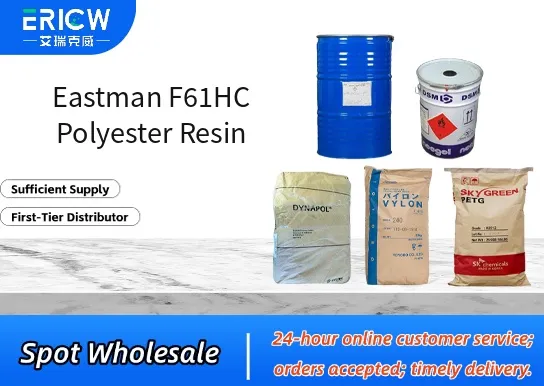
Q1: What is the primary application of Eastman F61HC Polyester Resin?
A: Eastman F61HC is a high-clarity, low-viscosity unsaturated polyester resin designed primarily for castable applications such as decorative stone composites, cultured marble, and translucent solid surface materials where excellent flow, air release, and depth of cure are required.
Q2: Is Eastman F61HC compatible with standard free-radical initiators?
A: Yes — Eastman F61HC is formulated to react efficiently with common organic peroxides such as MEKP (methyl ethyl ketone peroxide) and BPO (benzoyl peroxide), enabling reliable room-temperature or elevated-temperature curing depending on initiator selection and formulation needs.
Q3: How does Eastman F61HC compare to conventional orthophthalic resins in terms of yellowing resistance?
A: Eastman F61HC exhibits improved UV stability and reduced tendency to yellow over time compared to many standard orthophthalic polyester resins, making it well-suited for applications where long-term clarity and color retention are critical — though performance depends on overall formulation, including UV absorbers and HALS stabilizers.
Q4: Can Eastman F61HC be used in food-contact applications?
A: Eastman F61HC is not pre-approved for direct food-contact use. Any potential use in food-contact systems must be evaluated by the formulator against applicable regulatory requirements and supported by full migration testing and compliance documentation specific to the final article and intended conditions of use.
Contact With Us:
E-mail: wangxingqiang@ericwchem.com
Have a Questions? Call Us:
Add:
Building A1, Jiete Industrial Park, Huangpu District, Guangzhou City, Guangdong Province, China