English
 Español
 tiếng việt
 русский
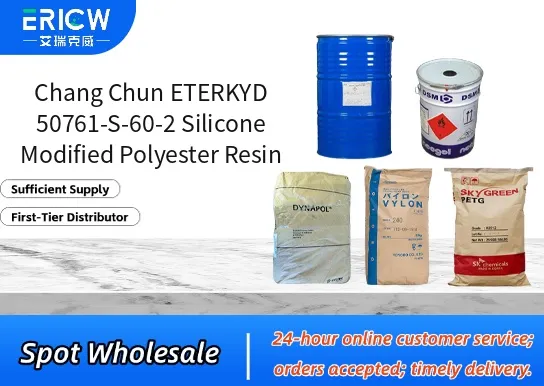
Enhanced thermal stability due to silicone modification, enabling reliable performance at elevated service temperatures.
Improved weather resistance and UV durability compared to standard polyester resins, reducing chalking and gloss loss over time.
Excellent compatibility with melamine formaldehyde crosslinkers for high-gloss, durable thermoset coatings.
Good flow and leveling characteristics in solvent-based coil and appliance coating formulations.
Reduced surface tension and improved substrate wetting, supporting uniform film formation on metal substrates.
Pre-painted metal (PPM) coatings for architectural wall panels and roofing systems.
High-performance coil coatings for HVAC components and industrial appliances.
Durable topcoats for outdoor metal furniture and garden equipment.
Functional base resins in heat-resistant industrial maintenance coatings.
Formulation component for premium-grade metal can and drum coatings requiring enhanced weatherability.
| Chemical Type | Silicone-modified saturated polyester resin |
| Product Form | Clear to pale yellow viscous liquid |
| Appearance | Homogeneous, transparent to slightly hazy solution |
| Solvent System | Xylene / butyl acetate blend (typical) |
| Solid Content (wt%) | 60 ± 1% |
| Acid Value (mg KOH/g) | 8–12 |
| Hydroxyl Value (mg KOH/g) | 45–55 |
| Viscosity (25°C, mPa·s) | 3,500–5,500 |
Q1: What is the primary functional benefit of silicone modification in this polyester resin?
A: The silicone modification enhances thermal stability, improves surface slip and mar resistance, and contributes to better substrate wetting—particularly beneficial in high-performance coil coating and metal finishing applications where durability and aesthetic consistency are critical.
Q2: Is ETERKYD 50761-S-60-2 compatible with standard polyester crosslinkers such as TGIC or HAA-based systems?
A: Yes, it is formulated for compatibility with common amino- and hydroxy-functional crosslinkers, including TGIC and HAA derivatives. Performance optimization may require minor adjustment of catalyst levels and cure schedules to accommodate its modified reactivity profile.
Q3: How does this resin perform under outdoor exposure conditions?
A: Due to the silicone-polyester hybrid structure, it offers improved UV resistance and gloss retention compared to conventional polyester resins, making it suitable for exterior architectural coatings and pre-painted metal applications requiring long-term weatherability.
Q4: Can this resin be used in low-bake or reduced-cure-temperature formulations?
A: It can be adapted for lower-cure systems, though full performance development typically requires formulation tuning—including catalyst selection and potential co-resin blending—to ensure complete crosslinking and optimal film properties at reduced temperatures.
Contact With Us:
E-mail: wangxingqiang@ericwchem.com
Have a Questions? Call Us:
Add:
Building A1, Jiete Industrial Park, Huangpu District, Guangzhou City, Guangdong Province, China