English
 Español
 tiếng việt
 русский
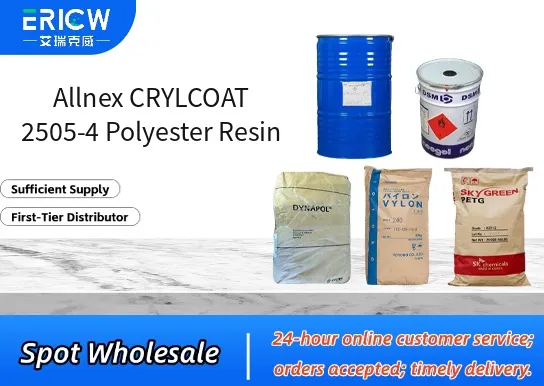
High-gloss, excellent flow and leveling for premium surface aesthetics.
Outstanding weather resistance and UV stability for long-term outdoor performance.
Good chemical resistance to common household cleaners and mild industrial solvents.
Optimized reactivity with standard triglycidyl isocyanurate (TGIC) curing agents.
Consistent batch-to-batch reproducibility meeting stringent quality control standards.
Architectural aluminum extrusions for curtain walls and window frames.
Outdoor furniture coatings requiring durability and color retention.
Automotive trim and non-structural exterior components.
General-purpose industrial metal coatings for agricultural and construction equipment.
Whitegoods and appliance housings exposed to ambient environmental conditions.
| Chemical Type | Carboxyl-functional saturated polyester |
| Product Form | Free-flowing granular solid |
| Appearance | Off-white to light beige granules |
| Acid Value (mg KOH/g) | 26–30 |
| Melt Viscosity (180°C, Pa·s) | 3.5–5.5 |
| Gardner Color | ≤ 3 |
| Particle Size (D90, µm) | ≤ 250 |
| Primary Applications | TGIC-cured powder coatings for exterior metal substrates |
Q1: What is the primary application of CRYLCOAT 2505-4 in powder coatings?
A: CRYLCOAT 2505-4 is a carboxyl-functional polyester resin specifically designed for use in TGIC-free, high-gloss, decorative powder coating systems—particularly where excellent flow, leveling, and long-term weather resistance are required.
Q2: Is CRYLCOAT 2505-4 compatible with standard epoxy-based curing agents?
A: No—CRYLCOAT 2505-4 is formulated for use with hydroxyalkylamide (HAA) crosslinkers, not epoxy resins. Its carboxyl functionality enables efficient reaction with HAA co-reactants under typical powder cure conditions (e.g., 180–200 °C).
Q3: How does CRYLCOAT 2505-4 perform in terms of UV stability and chalking resistance?
A: As a premium-grade aromatic polyester, it delivers strong inherent UV resistance and low chalk formation in outdoor applications—especially when formulated with appropriate HALS and UV absorbers and applied at recommended film thicknesses.
Q4: Can CRYLCOAT 2505-4 be blended with other polyester resins to modify performance?
A: Yes—blending with complementary carboxyl-functional polyesters (e.g., higher-acid-value or lower-Tg grades) is common practice to fine-tune melt viscosity, flexibility, or cure response, though compatibility and final properties should be verified through lab-scale testing.
Contact With Us:
E-mail: wangxingqiang@ericwchem.com
Have a Questions? Call Us:
Add:
Building A1, Jiete Industrial Park, Huangpu District, Guangzhou City, Guangdong Province, China