English
 Español
 tiếng việt
 русский
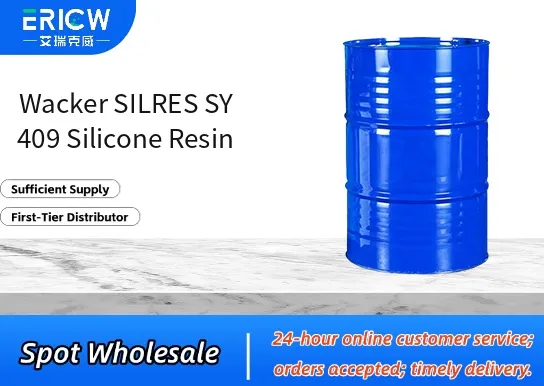
High thermal stability with continuous service up to 250 °C.
Excellent weather resistance and UV stability for long-term outdoor performance.
Good compatibility with organic resins, enabling hybrid formulation systems.
Low surface energy providing inherent water repellency and anti-soiling properties.
Solvent-based liquid format for easy integration into coating and impregnation processes.
Heat-resistant coatings for industrial exhaust systems and furnace components.
Weatherproofing additives in architectural silicone-modified paints and façade systems.
Water-repellent impregnation agents for mineral building materials (e.g., concrete, brick, natural stone).
Matrix resin in high-performance composite laminates requiring thermal and environmental durability.
Binders for ceramic and refractory coatings used in metallurgical and energy applications.
| Chemical Type | Methyl-phenyl silicone resin |
| Product Form | Liquid |
| Appearance | Clear, colorless to pale yellow viscous liquid |
| Solvent | Xylene / aromatic hydrocarbon blend |
| Solids Content | Approx. 50 wt% |
| Viscosity (25 °C) | Approx. 1,200–1,800 mPa·s |
| Density (20 °C) | Approx. 0.98–1.02 g/cm³ |
| VOC Content | Compliant with EU Directive 2004/42/EC (Category C2) |
Q1: What is the primary function of SILRES SY 409 in coating formulations?
A: SILRES SY 409 functions primarily as a hydrophobizing and surface-modifying additive, enhancing water repellency, improving dirt resistance, and promoting substrate wetting—especially on mineral-based surfaces such as concrete, render, and masonry.
Q2: Is SILRES SY 409 compatible with waterborne acrylic or silicate-based systems?
A: Yes, SILRES SY 409 is specifically designed for compatibility with aqueous systems including waterborne acrylic dispersions, potassium silicate binders, and hybrid silicate-acrylic matrices. It typically remains stable without phase separation when properly dispersed and incorporated under standard formulation conditions.
Q3: How should SILRES SY 409 be added to a formulation to ensure optimal performance?
A: It is recommended to add SILRES SY 409 during the let-down stage, after pigments and fillers have been fully dispersed. Gentle stirring at low shear is sufficient; high-shear mixing is not required. Pre-dilution with water or co-solvent may aid uniform incorporation depending on system viscosity and pH.
Q4: Does SILRES SY 409 affect film formation or drying behavior in coatings?
A: SILRES SY 409 generally does not interfere with film formation of common binder systems. It may slightly extend surface drying time due to its surface-active nature, but bulk drying and crosslinking kinetics remain largely unaffected when used within typical dosage ranges.
Q5: Can SILRES SY 409 be used in exterior facade coatings exposed to UV and weathering?
A: Yes—SILRES SY 409 contributes to long-term durability in exterior applications by reinforcing the hydrophobic barrier and supporting resistance against cyclic wetting/drying and UV-induced surface degradation, particularly when formulated with UV-stable binders.
Contact With Us:
E-mail: wangxingqiang@ericwchem.com
Have a Questions? Call Us:
Add:
Building A1, Jiete Industrial Park, Huangpu District, Guangzhou City, Guangdong Province, China