English
 Español
 tiếng việt
 русский
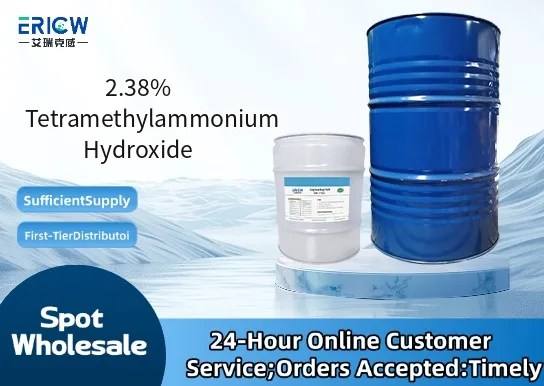
Ultra-low metal ion content (≤10 ppb Na, K, Fe), ideal for high-purity semiconductor and display manufacturing processes.
Stable aqueous solution with precise 2.38 wt% concentration—optimized for consistent etch rate control in photolithography development.
Non-volatile, non-oxidizing base with minimal residue formation after evaporation or rinsing.
Excellent compatibility with common photoresists (including chemically amplified resists) and anti-reflective coatings.
Supplied in cleanroom-certified, nitrogen-purged HDPE or fluoropolymer-lined containers to prevent CO₂ absorption and carbonate formation.
Photoresist developer in advanced LCD, OLED, and microLED display fabrication lines.
Etchant for silicon dioxide and silicon nitride thin films in MEMS and sensor manufacturing.
Stripping agent for post-etch residue removal in 300 mm wafer processing.
Buffer component in CMP (Chemical Mechanical Polishing) slurry formulations for tungsten and copper planarization.
Surface pretreatment solution for enhancing adhesion of dielectric layers in advanced packaging (e.g., Fan-Out WLP).
| Chemical Type | Quaternary ammonium hydroxide |
| Product Form | Aqueous solution |
| Appearance | Clear, colorless liquid |
| Concentration | 2.38 ± 0.05 wt% TMAH (as TMAH·5H₂O equivalent) |
| pH (25°C) | 13.4–13.6 |
| Density (25°C) | 1.008–1.012 g/cm³ |
| Primary Applications | Photolithographic resist development, thin-film etching, cleaning, and surface modification |
| Regulatory Compliance | REACH registered; RoHS compliant; SDS available per GHS Rev. 8 |
| Common Compatible Systems | Suitability |
| Standard spin coater & puddle developer tools (e.g., Tokyo Electron CLEAN TRACK series) | Highly Recommended – Fully validated for process stability and particle control |
| DI water rinse systems with ultra-low TOC (<5 ppb) and sub-0.1 µm filtration | Highly Recommended – Prevents re-deposition and maintains critical dimension uniformity |
| Stainless steel (316L) and fluoropolymer (PFA, FEP) fluid handling components | Recommended – Corrosion-resistant under continuous recirculation at ambient temperature |
| UV-LED curing modules used in hybrid resist processing | Suitable – No interference with UV transmission or crosslinking kinetics |
Q1: What is the CAS Number for 2.38% Tetramethylammonium Hydroxide?
A: The CAS Number for tetramethylammonium hydroxide monohydrate (common basis for commercial 2.38% solutions) is 75-59-2; the pentahydrate form is 10424-65-6. Our 2.38% product is formulated from high-purity TMAH·5H₂O.
Q2: How does the 2.38% concentration compare to other standard TMAH concentrations (e.g., 0.26% or 5%) in lithography?
A: 2.38% represents the industry-standard concentration for high-resolution i-line and KrF photoresist development, balancing etch rate, contrast, and process window—unlike lower concentrations (0.26%) used for ultra-thin resists or higher concentrations (5%) requiring dilution and tighter temperature control.
Q3: Is there risk of TMAH migration into silicon wafers or polymer substrates during processing?
A: Under standard development conditions (23–25°C, 30–90 sec dwell time), TMAH exhibits negligible bulk diffusion into crystalline silicon or PI/PET substrates; residual surface traces are fully removed by DI water rinse and N₂ dry steps per SEMI standard C34–0212.
Q4: Does this product meet ISO 14644-1 Class 5 (Class 100) cleanroom handling requirements?
A: Yes—bottled under ISO Class 4 (Class 10) conditions; certified ≤1 particle ≥0.2 µm per mL (per USP <788> and SEMI F57–1106); particulate data provided on CoA with each lot.
Contact With Us:
E-mail: wangxingqiang@ericwchem.com
Have a Questions? Call Us:
Add:
Building A1, Jiete Industrial Park, Huangpu District, Guangzhou City, Guangdong Province, China