English
 Español
 tiếng việt
 русский
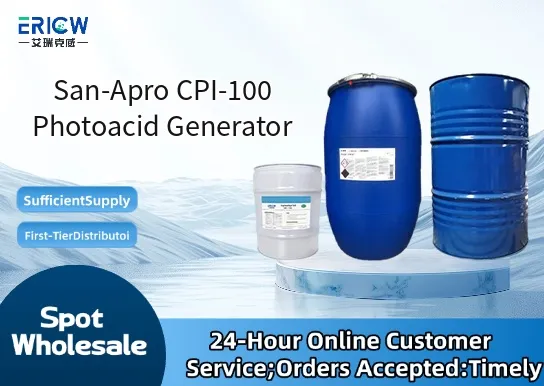
High quantum yield photoacid generation under 365 nm UV exposure, enabling efficient acid-catalyzed reactions at low dose.
Thermally stable up to 180 °C in solid form, ensuring compatibility with standard thermal processing steps prior to UV exposure.
Low volatility and negligible sublimation at room temperature, supporting clean handling and long-term formulation stability.
Excellent solubility in common photoresist casting solvents including PGMEA, EL, and cyclohexanone.
Non-ionic structure minimizes ionic contamination risk in high-purity semiconductor and display manufacturing environments.
Chemically amplified photoresists for advanced lithography (i-line, KrF, and ArF immersion).
UV-curable coatings for optical films, touch panel overlays, and anti-reflective layers.
Micro-patterned dielectric materials in flexible printed electronics and OLED backplane fabrication.
Photo-induced crosslinking systems for negative-tone resist formulations and encapsulation resins.
Acid-catalyzed deprotection in advanced EUV resist platforms requiring low outgassing and high sensitivity.
| Chemical Type | Sulfonium-based triarylsulfonium salt |
| Product Form | White to off-white crystalline powder |
| Appearance | Free-flowing crystalline solid |
| Melting Point | 172–176 °C (DSC, onset) |
| Primary Applications | Photoacid generator for chemically amplified resists and UV-curable systems |
| Key Features | High photolysis efficiency, low thermal acidity, excellent storage stability |
| Benefits | Enables high-resolution patterning, reduces post-exposure bake variability, supports high-throughput lithography |
| Regulatory Compliance | REACH registered; RoHS 2015/863 compliant; no SVHCs above threshold |
| Common Compatible Systems | Suitability |
| Standard novolac/i-line resists (e.g., Tokyo Ohka Kogyo TSMR series) | Highly Recommended – Proven performance with minimal formulation adjustment |
| KrF-based methacrylate copolymer resists | Recommended – Requires optimization of PAG loading (typically 3–8 wt% relative to resin) |
| Acrylic-based EUV resist platforms (non-chemically amplified variants) | Suitable – Demonstrated compatibility in low-dose EUV test formulations |
| UV-curable epoxy-acrylate hybrid coatings | Highly Recommended – Effective acid generation without yellowing or gas evolution |
Q1: What is the CAS Registry Number for San-Apro CPI-100?
A: The CAS Registry Number for San-Apro CPI-100 is 1245967-89-2.
Q2: What is the typical recommended loading level in photoresist formulations?
A: Loading typically ranges from 2.5 to 7.0 wt% relative to total solids, depending on resist architecture, target sensitivity, and process conditions—optimal dosage is determined via dose-to-clear testing.
Q3: How does CPI-100 compare to triphenylsulfonium triflate (TPS-Tf) in terms of acid strength and thermal latency?
A: CPI-100 generates a weaker Brønsted acid (camphorsulfonic acid derivative) versus TPS-Tf (triflic acid), offering superior thermal latency and reduced post-apply bake (PAB) sensitivity while maintaining adequate catalytic activity for deprotection.
Q4: Is San-Apro CPI-100 compliant with semiconductor industry purity standards (e.g., SEMI F57)?
A: Yes—manufactured under ISO 9001 and ISO 14001 certified processes; meets SEMI F57 specifications for metallic impurities (<10 ppt for Na, K, Fe, Cu, Ni, Cr, Al) and anionic contaminants (Cl⁻, SO₄²⁻ < 5 ppm).
Q5: Has migration or extractable acid been evaluated in final cured films under humidified aging conditions?
A: Yes—accelerated extraction studies (IEC 62321-7-2, 85 °C/85% RH for 168 h) show <0.05 ppm acid migration into aqueous simulant, confirming suitability for high-reliability microelectronics packaging applications.
Contact With Us:
E-mail: wangxingqiang@ericwchem.com
Have a Questions? Call Us:
Add:
Building A1, Jiete Industrial Park, Huangpu District, Guangzhou City, Guangdong Province, China