English
 Español
 tiếng việt
 русский
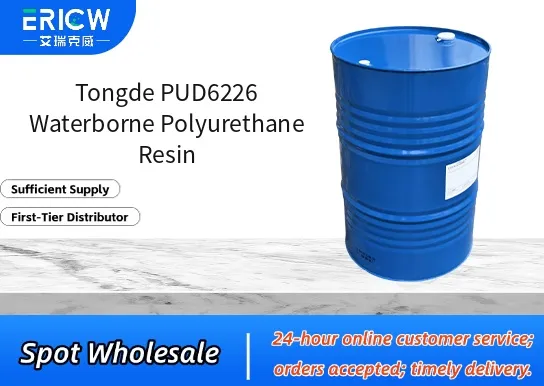
Excellent film-forming capability with high gloss and clarity after drying.
Superior abrasion and scratch resistance for demanding end-use environments.
Low VOC content, compliant with stringent environmental and occupational safety regulations.
Good compatibility with acrylic emulsions and water-based additives for formulation flexibility.
Stable viscosity profile across a broad pH range (6.5–8.5) and storage temperature (5–35°C).
Water-based leather finishing topcoats for footwear and furniture.
High-performance coatings for flexible packaging laminates.
Industrial wood coatings requiring chemical resistance and mar resistance.
Textile coating binders for synthetic fabrics requiring breathability and soft hand feel.
Adhesive modifiers in water-based laminating adhesives for composite materials.
| Chemical Type | Aliphatic anionic waterborne polyurethane dispersion |
| Product Form | Opaque milky white liquid |
| Appearance | Homogeneous, free of sediment or coagulum |
| Solids Content (wt%) | 30.0 ± 1.0% |
| pH Value (25°C) | 7.2 ± 0.3 |
| Viscosity (mPa·s, Brookfield RVT, #2 spindle, 20 rpm, 25°C) | 150–350 |
| Particle Size (nm, D50) | 80–120 |
| Minimum Film Formation Temperature (MFFT) | ≤ 15°C |
Q1: What are the primary application areas for Tongde PUD6226?
A: Tongde PUD6226 is widely used in high-performance waterborne coatings for flexible substrates, including synthetic leather finishing, textile coatings, and soft-touch decorative films. Its balanced film-forming ability and mechanical resilience make it especially suitable for applications requiring good elongation, abrasion resistance, and low-temperature flexibility.
Q2: How should Tongde PUD6226 be stored and handled to maintain stability?
A: Store in tightly sealed containers at temperatures between 5–35°C, away from direct sunlight and freezing conditions. Avoid prolonged exposure to high humidity or contamination with incompatible materials such as strong acids, bases, or solvents. Stir gently before use to ensure homogeneity, and do not dilute with hard water or untreated tap water.
Q3: Can Tongde PUD6226 be blended with other waterborne resins or additives?
A: Yes, Tongde PUD6226 demonstrates good compatibility with many common waterborne acrylics, polyurethane dispersions, and crosslinkers (e.g., aziridine or carbodiimide types). However, compatibility testing under actual formulation conditions—including pH, ionic strength, and shear history—is strongly recommended prior to full-scale blending.
Q4: Does Tongde PUD6226 require a coalescing agent or organic solvent for film formation?
A: Tongde PUD6226 is formulated to form continuous films at ambient conditions without mandatory coalescent aid. In some demanding applications—such as low-temperature curing or high-solids formulations—a small amount of low-VOC coalescent may be considered, but its necessity depends on substrate, drying conditions, and final performance targets.
Q5: Is Tongde PUD6226 compatible with pigment dispersions commonly used in waterborne systems?
A: Yes, Tongde PUD6226 generally exhibits good compatibility with anionic and nonionic pigment dispersants and pre-dispersed color pastes designed for waterborne polyurethane or acrylic systems. For optimal color development and dispersion stability, we recommend evaluating pigment loading, shear history, and pH alignment during formulation development.
Contact With Us:
E-mail: wangxingqiang@ericwchem.com
Have a Questions? Call Us:
Add:
Building A1, Jiete Industrial Park, Huangpu District, Guangzhou City, Guangdong Province, China