English
 Español
 tiếng việt
 русский
High-performance aliphatic polyurethane dispersion with excellent UV resistance and gloss retention.
Low-VOC, waterborne formulation compliant with stringent environmental and regulatory requirements.
Outstanding chemical resistance to household cleaners, mild acids, and alkalis.
Good film formation at ambient temperature with balanced drying speed and open time.
Compatible with common coalescing agents and crosslinkers for enhanced hardness and mar resistance.
Waterborne wood coatings for interior furniture and cabinetry.
Architectural wall and ceiling coatings requiring durability and low emissions.
Industrial maintenance coatings for metal substrates in non-corrosive environments.
Coatings for MDF and particleboard panels used in residential interiors.
Basecoats and topcoats in decorative laminate finishing systems.
| Chemical Type | Aliphatic polyurethane dispersion |
| Product Form | Waterborne liquid |
| Appearance | Opaque white to off-white liquid |
| pH (at 25°C) | 7.5 – 8.5 |
| Solids Content (wt%) | 38 – 42 |
| Viscosity (mPa·s, Brookfield RVT, #2 spindle, 20 rpm) | 150 – 350 |
| Density (g/cm³, 20°C) | 1.02 – 1.06 |
| Minimum Film Formation Temperature (MFFT) | ≥ 15°C |
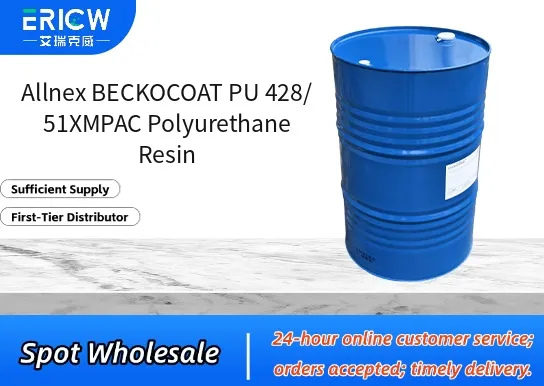
Q1: What is the primary application of BECKOCOAT PU 428/51XMPAC?
A: BECKOCOAT PU 428/51XMPAC is a solvent-based, low-viscosity polyurethane resin designed primarily as a crosslinker or performance modifier in high-performance industrial coatings—especially for wood, plastic, and metal substrates requiring excellent chemical resistance, flexibility, and gloss retention.
Q2: Is this resin compatible with common acrylic or polyester hydroxyl-functional resins?
A: Yes, BECKOCOAT PU 428/51XMPAC is formulated to react efficiently with standard hydroxyl-functional resins, including acrylics and polyesters, under conventional curing conditions. Compatibility and cure response should be verified in the final formulation due to system-specific variables such as catalyst type, solvent blend, and film thickness.
Q3: What is the recommended curing profile for optimal performance?
A: Optimal cure is typically achieved at elevated temperatures (e.g., 120–160 °C), with time depending on substrate and oven configuration. Lower-temperature cure is possible with suitable catalysts, though full property development—including hardness, chemical resistance, and adhesion—may require extended dwell time or post-bake conditioning.
Q4: How should BECKOCOAT PU 428/51XMPAC be stored and handled?
A: Store in tightly sealed original containers in a cool, dry, well-ventilated area away from moisture, heat sources, and direct sunlight. Prolonged exposure to ambient humidity may cause premature reaction or viscosity increase. Always observe standard industrial hygiene practices when handling solvent-based polyurethanes.
Contact With Us:
E-mail: wangxingqiang@ericwchem.com
Have a Questions? Call Us:
Add:
Building A1, Jiete Industrial Park, Huangpu District, Guangzhou City, Guangdong Province, China