English
 Español
 tiếng việt
 русский
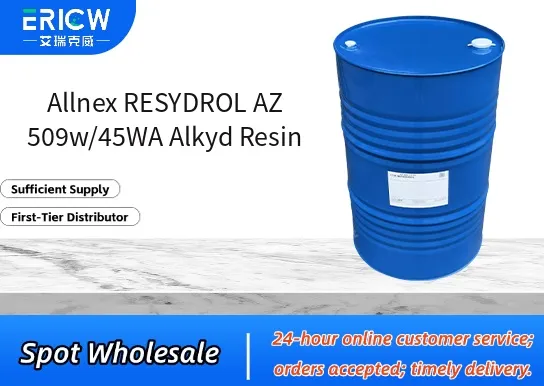
Water-reducible alkyd resin enabling low-VOC, high-performance coatings without organic co-solvents.
Excellent gloss retention and film hardness development after ambient cure.
Superior compatibility with acrylic emulsions and other waterborne resins for hybrid systems.
Good hydrolytic stability and shelf life in aqueous dispersions.
Enables excellent substrate wetting and flow on wood, metal, and primed surfaces.
Interior and exterior architectural wood coatings (e.g., trim, doors, cabinetry).
Waterborne industrial maintenance coatings for metal substrates.
Low-VOC decorative finishes for furniture and DIY consumer products.
Hybrid waterborne-acrylic topcoats requiring enhanced alkyd-like aesthetics and durability.
Primers and undercoats where fast dry-to-touch and good sandability are required.
| Chemical Type | Water-reducible alkyd resin (modified phthalic-based) |
| Product Form | Aqueous dispersion |
| Appearance | Opaque white to off-white liquid |
| pH (10% in water) | 7.5–8.5 |
| Non-Volatile Content (wt%) | 44–46% |
| Viscosity (Brookfield, RVT, Spindle #3, 20 rpm, 25°C) | 150–350 mPa·s |
| Particle Size (D50) | 0.2–0.5 µm |
| Free Formaldehyde | <50 ppm |
Q1: What is the primary function of RESYDROL AZ 509w/45WA in waterborne alkyd formulations?
A: RESYDROL AZ 509w/45WA is a water-reducible alkyd resin designed to provide excellent film formation, gloss development, and substrate adhesion in low-VOC, waterborne architectural and industrial coatings. It enables formulators to achieve alkyd-like performance—such as hardness build and recoatability—without relying on high levels of co-solvents.
Q2: Is RESYDROL AZ 509w/45WA compatible with acrylic emulsions and other common waterborne binders?
A: Yes, it demonstrates good compatibility with a wide range of acrylic, vinyl-acrylic, and styrene-acrylic emulsions, enabling hybrid systems that balance alkyd aesthetics with acrylic durability and early water resistance. Compatibility testing under specific formulation conditions is recommended to optimize stability and film properties.
Q3: How should RESYDROL AZ 509w/45WA be neutralized for optimal water dispersion?
A: The resin is typically neutralized with low-molecular-weight amines such as dimethylethanolamine (DMEA) or triethylamine (TEA) at levels sufficient to achieve stable dispersion and desired viscosity. Neutralization level should be adjusted based on target pH (commonly between 7.5–8.5), solids content, and co-binder interactions.
Q4: Does this resin require a catalyst for ambient-cure applications?
A: While RESYDROL AZ 509w/45WA exhibits inherent oxidative drying behavior typical of alkyds, ambient cure speed and final film hardness can be enhanced using conventional driers (e.g., cobalt-, zirconium-, or calcium-based). Drier selection and dosage depend on formulation requirements, regulatory considerations, and performance targets.
Contact With Us:
E-mail: wangxingqiang@ericwchem.com
Have a Questions? Call Us:
Add:
Building A1, Jiete Industrial Park, Huangpu District, Guangzhou City, Guangdong Province, China