English
 Español
 tiếng việt
 русский
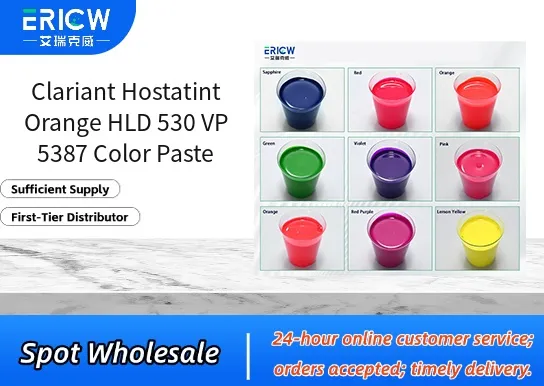
High chroma orange shade with excellent lightfastness and weather resistance for long-term color stability.
Optimized rheology for easy dispersion and uniform incorporation into water-based systems without agglomeration.
Low volatile organic compound (VOC) content, supporting compliance with stringent environmental and regulatory requirements.
Excellent compatibility with common acrylic, styrene-acrylic, and vinyl acetate copolymer dispersions.
Stable storage performance with minimal settling or separation under standard warehouse conditions (5–30 °C).
Architectural interior and exterior wall paints.
Industrial maintenance coatings for metal and concrete substrates.
Water-based wood stains and clear finishes.
Decorative plasters and textured coating systems.
Non-food-contact plastic coatings and functional surface treatments.
| Chemical Type | Organic pigment dispersion (azo-based) |
| Product Form | Liquid color paste, aqueous medium |
| Appearance | Homogeneous orange suspension, free of visible particles |
| Primary Applications | Water-based architectural and industrial coatings |
| Key Features | High tinctorial strength, low foam generation, shear-stable |
| Benefits | Reduced dosage requirement, improved batch-to-batch consistency, simplified production integration |
| pH (25 °C) | 7.5–9.0 |
| Specific Gravity (20 °C) | 1.10–1.20 g/cm³ |
Q1: What types of polymers is Hostatint Orange HLD 530 VP 5387 compatible with?
A: This orange color paste is specifically formulated for use in polyolefins such as PP and HDPE, and demonstrates good compatibility in engineering thermoplastics including ABS and PS. Performance in polar resins or elastomers may require prior compatibility testing.
Q2: How should this color paste be incorporated into polymer processing?
A: It is designed for direct addition to the base polymer during compounding or injection molding—typically via gravimetric or volumetric feeders. Pre-blending with a portion of the base resin before main extrusion helps ensure uniform dispersion and minimizes streaking.
Q3: Does this product offer heat stability suitable for high-temperature processing?
A: Yes, Hostatint Orange HLD 530 VP 5387 is engineered for thermal stability in standard polyolefin processing conditions, including extrusion and injection molding up to approximately 240 °C. Extended residence time at peak temperatures may affect hue intensity and should be evaluated under actual process conditions.
Q4: Is this color paste suitable for applications requiring regulatory compliance for food contact or toys?
A: Hostatint Orange HLD 530 VP 5387 is developed for non-food-contact industrial and consumer goods applications. For regulated end uses—including food packaging or children’s products—formulators must conduct full regulatory assessment based on final article composition, processing, and applicable regional requirements.
Q5: What is the typical dosage range for achieving target shade intensity?
A: Dosage depends on polymer type, desired opacity, and processing method, but it is generally used at low concentrations—typically ranging from 0.1% to 2% by weight relative to the base resin. Optimal loading should be determined through lab-scale trials to balance color strength, dispersion quality, and mechanical properties.
Contact With Us:
E-mail: wangxingqiang@ericwchem.com
Have a Questions? Call Us:
Add:
Building A1, Jiete Industrial Park, Huangpu District, Guangzhou City, Guangdong Province, China