English
 Español
 tiếng việt
 русский
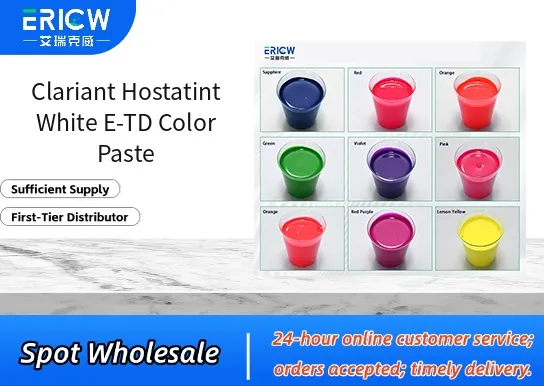
High-opacity, titanium dioxide–based white dispersion for superior hiding power and brightness.
Excellent compatibility with water-based and solvent-based systems including acrylics, alkyds, and polyurethanes.
Optimized rheology for easy incorporation and stable storage without sedimentation or separation.
Low VOC formulation supporting compliance with global environmental and regulatory standards.
Consistent batch-to-batch color strength and dispersion quality ensured by Clariant’s stringent quality control.
Architectural and decorative coatings for interior and exterior walls.
Industrial maintenance coatings for metal and concrete substrates.
Wood coatings including primers, sealers, and topcoats.
Automotive refinish basecoats and primer-surfacer systems.
Plastic coatings and in-can tinting systems for OEM and aftermarket applications.
| Chemical Type | Titanium dioxide (TiO₂) pigment dispersion |
| Product Form | Ready-to-use liquid color paste |
| Appearance | Opaque white paste, homogeneous and free of grit |
| Primary Applications | Water-based and solvent-based industrial and architectural coatings |
| Key Features | High opacity, excellent dispersibility, low viscosity |
| Benefits | Improved coverage efficiency, reduced formulation complexity, enhanced storage stability |
| Recommended Use Level | 1–15% by weight, depending on final opacity requirements |
| Storage Conditions | Store at 5–30°C; protect from freezing and direct sunlight |
Q1: What is the primary application of Hostatint White E-TD Color Paste?
A: Hostatint White E-TD Color Paste is specifically developed for coloring polyolefin-based packaging materials, including flexible films and rigid containers, where excellent thermal stability, dispersion performance, and low extractables are required.
Q2: Is this product suitable for food-contact applications?
A: Yes — Hostatint White E-TD Color Paste is formulated to meet general regulatory expectations for food-contact plastics in major global markets, including compliance with FDA guidelines for indirect food additives and EU framework regulations. Final compliance depends on full formulation assessment and intended use conditions.
Q3: How should the paste be incorporated into polyolefin compounds?
A: It is typically introduced via masterbatch dilution or direct addition during extrusion compounding. Good melt mixing and adequate residence time ensure uniform dispersion; pre-drying is not required, but moisture control of the base polymer remains recommended.
Q4: What is the typical dosage range for effective coloring?
A: Dosage generally ranges from 0.1% to 2% by weight relative to the base polymer, depending on the desired opacity, whiteness intensity, and substrate thickness. Optimization is recommended for each specific process and formulation.
Contact With Us:
E-mail: wangxingqiang@ericwchem.com
Have a Questions? Call Us:
Add:
Building A1, Jiete Industrial Park, Huangpu District, Guangzhou City, Guangdong Province, China