English
 Español
 tiếng việt
 русский
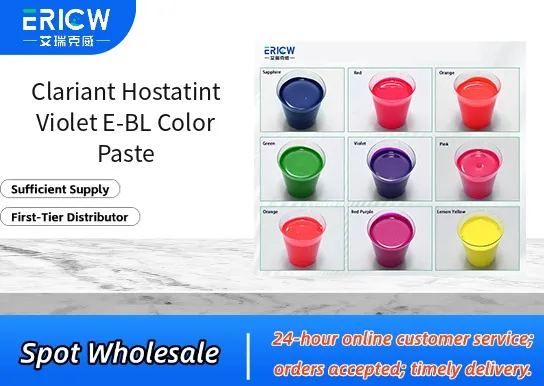
High chroma violet shade with excellent batch-to-batch color consistency.
Optimized for high-solids, low-VOC water-based systems without compromising dispersion stability.
Excellent lightfastness and thermal stability up to 180 °C for demanding processing conditions.
Low migration profile, suitable for applications requiring compliance with food-contact regulations (EU 10/2011, FDA 21 CFR §178.3297).
Easy incorporation and rapid wetting in aqueous polymer dispersions and acrylic emulsions.
Architectural and decorative waterborne interior/exterior paints.
Industrial maintenance coatings for metal and concrete substrates.
Water-based wood stains and clear finishes for furniture and flooring.
Printing inks for flexible packaging and paperboard (non-food-contact layers).
Water-based adhesives and sealants requiring vibrant, stable violet tinting.
| Chemical Type | Organic pigment dispersion (Violet 23) |
| Product Form | Concentrated aqueous color paste |
| Appearance | Pourable, homogeneous violet liquid |
| Primary Applications | Water-based architectural, industrial, and wood coatings |
| Key Features | High tinctorial strength, low foam generation, non-settling |
| Benefits | Reduced dosing volume, improved formulation efficiency, extended shelf life (>12 months at 5–30 °C) |
| pH (25 °C) | 7.5 – 8.5 |
| Non-Volatile Content (wt%) | 38 – 42% |
Q1: What is the primary application field for Hostatint Violet E-BL Color Paste?
A: Hostatint Violet E-BL is specifically developed for coloring polyolefin-based packaging materials, including flexible films and rigid containers intended for food contact applications—where high thermal stability, excellent dispersion, and low extractables are critical.
Q2: Is this color paste compatible with polypropylene (PP) and polyethylene (PE) processing conditions?
A: Yes, Hostatint Violet E-BL is formulated to withstand typical polyolefin extrusion and injection molding temperatures (up to approximately 260 °C), offering good thermal stability and minimal color shift during high-shear compounding or film blowing.
Q3: How should this paste be incorporated into a polymer matrix?
A: It is typically introduced via masterbatch dilution or direct addition during compounding. Good mixing efficiency is achieved using standard twin-screw extruders; pre-dispersion in a carrier resin may be recommended for optimal homogeneity in demanding applications.
Q4: Does Hostatint Violet E-BL meet regulatory requirements for food-contact plastics?
A: This product is designed and manufactured in accordance with Clariant’s stringent quality and compliance protocols for food-contact applications. Regulatory suitability depends on final formulation, processing conditions, and regional requirements; users must verify compliance with applicable local regulations prior to commercial use.
Contact With Us:
E-mail: wangxingqiang@ericwchem.com
Have a Questions? Call Us:
Add:
Building A1, Jiete Industrial Park, Huangpu District, Guangzhou City, Guangdong Province, China