English
 Español
 tiếng việt
 русский
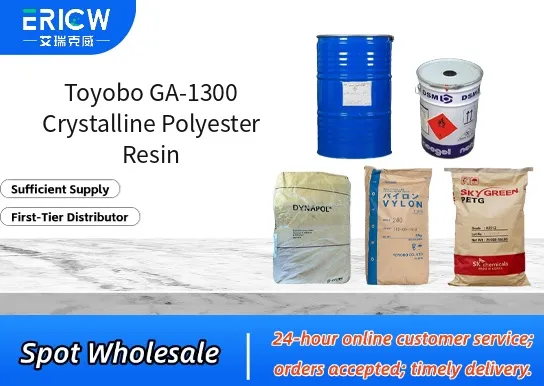
Highly crystalline structure enabling rapid melt-solidification and excellent dimensional stability.
Outstanding thermal resistance with melting point of approximately 245–255 °C.
Low melt viscosity for enhanced processability in extrusion, injection molding, and powder coating applications.
Excellent chemical resistance to hydrocarbons, alcohols, and weak acids under ambient conditions.
Good compatibility with common polyolefin modifiers and nucleating agents for tailored crystallinity control.
Powder coatings for metal substrates requiring high-gloss, durable finishes.
Engineering thermoplastic composites in automotive interior trim and under-hood components.
Specialty filaments for high-temperature FDM 3D printing.
Hot-melt adhesives for laminated packaging requiring heat resistance above 100 °C.
| Chemical Type | Copolyester (aromatic-aliphatic crystalline) |
| Product Form | Pellets |
| Appearance | Off-white to light beige granules |
| Melting Point (DSC, 10 °C/min) | 248–253 °C |
| Crystallinity (DSC) | 40–45% (by enthalpy) |
| Melt Flow Rate (250 °C / 2.16 kg) | 8–12 g/10 min |
| Density (23 °C) | 1.32–1.35 g/cm³ |
| Moisture Content (as received) | ≤ 0.2 wt% |
Q1: What is the primary functional role of GA-1300 in powder coating formulations?
A: GA-1300 serves as a crystalline polyester resin designed to enhance flow, leveling, and edge coverage in thermosetting powder coatings—particularly in hybrid and pure polyester systems—by providing controlled melt viscosity and rapid crystallization upon cooling.
Q2: How does GA-1300 differ from conventional amorphous polyesters used in powder coatings?
A: Unlike amorphous polyesters, GA-1300 exhibits sharp crystallinity, resulting in lower storage viscosity at ambient temperature, improved physical handling stability, and reduced blocking tendency—while maintaining compatibility with standard epoxy curing agents like TGIC or HAA.
Q3: Is GA-1300 suitable for low-cure or energy-efficient powder coating processes?
A: Yes—its well-defined crystalline structure supports faster melt onset and efficient crosslinking kinetics, making it compatible with reduced-cure schedules (e.g., 160–170°C for 15–20 minutes), though optimal performance depends on full formulation synergy with curatives and additives.
Q4: What are the recommended storage and handling conditions for GA-1300?
A: Store in original sealed packaging under cool, dry conditions (below 30°C) and protect from humidity and direct sunlight. Due to its crystalline nature, avoid prolonged exposure to elevated temperatures prior to use to prevent partial melting or agglomeration.
Contact With Us:
E-mail: wangxingqiang@ericwchem.com
Have a Questions? Call Us:
Add:
Building A1, Jiete Industrial Park, Huangpu District, Guangzhou City, Guangdong Province, China