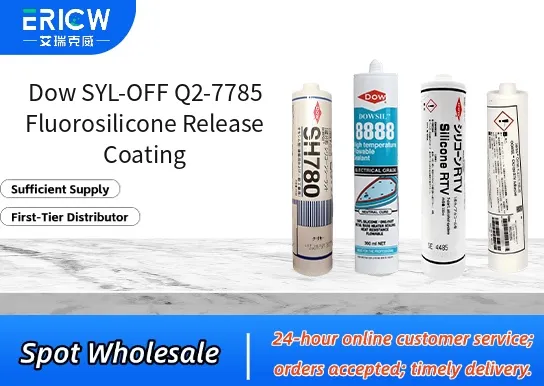
Combines fluorosilicone chemistry for exceptional release performance across high-temperature and aggressive chemical environments.
Provides long-term, consistent release durability on silicone rubber, EPDM, and other elastomeric substrates.
Offers excellent thermal stability with continuous service capability up to 200 °C (392 °F).
Delivers low surface energy and minimal residue transfer, supporting clean part release in precision manufacturing.
Compatible with conventional solvent-based coating systems and standard industrial application methods (e.g., roll coat, spray, dip).
Release liners for pressure-sensitive adhesives used in medical tapes and wound care products.
Tooling release coatings for high-temperature silicone molding of automotive gaskets and seals.
Surface treatment of mandrels and cores in composite aerospace component fabrication.
Release enhancement for silicone encapsulation molds in electronics potting and conformal coating processes.
Non-stick barrier layers in food-grade elastomer processing equipment.
| Chemical Type | Fluorosilicone polymer solution |
| Product Form | Liquid concentrate (solvent-based) |
| Appearance | Clear to slightly hazy, colorless to pale yellow liquid |
| Primary Applications | High-performance release coating for elastomers and composites |
| Key Features | Thermal stability, low residue, fluorosilicone-enhanced release |
| Benefits | Extended mold life, reduced downtime, improved part consistency |
| Solvent System | Aromatic hydrocarbon blend (typical) |
| VOC Content | Compliant with major regional regulatory limits (e.g., EPA, EU REACH) |
Q1: What substrates is Q2-7785 typically applied to?
A: Q2-7785 is commonly used on silicone rubber, fluorosilicone elastomers, and certain high-performance thermoplastics where low surface energy and robust release performance are required—especially in demanding thermal or chemical environments.
Q2: How is Q2-7785 typically applied and cured?
A: It is generally applied via spraying, dipping, or roll coating, followed by thermal curing at elevated temperatures—typically between 120 °C and 180 °C for several minutes—to achieve optimal crosslinking and release functionality.
Q3: Can Q2-7785 be diluted, and what solvents are compatible?
A: Yes, Q2-7785 can be diluted with aromatic or aliphatic hydrocarbon solvents (e.g., xylene, VM&P naphtha) or specific ketones—formulators should confirm compatibility and evaporation profile through lab-scale testing prior to full-scale use.
Q4: Does Q2-7785 offer resistance to aggressive media such as fuels or hydraulic fluids?
A: Due to its fluorosilicone backbone, Q2-7785 provides enhanced resistance to non-polar fluids—including many aviation fuels, lubricants, and synthetic hydraulic oils—compared to standard silicone release coatings.
Contact With Us:
E-mail: wangxingqiang@ericwchem.com
Have a Questions? Call Us:
Add:
Building A1, Jiete Industrial Park, Huangpu District, Guangzhou City, Guangdong Province, China
 English
 Español
 tiếng việt
 русский