English
 Español
 tiếng việt
 русский
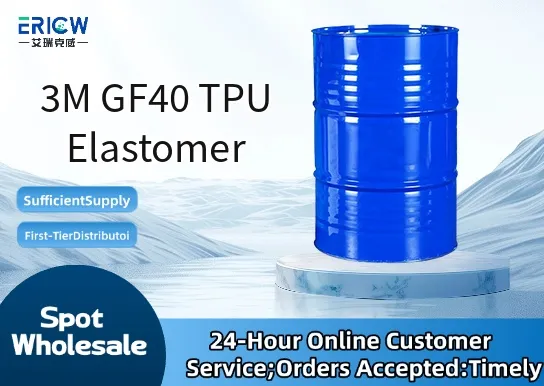
High abrasion resistance for extended service life in demanding mechanical environments.
Excellent oil and grease resistance, maintaining performance in lubricated or hydrocarbon-exposed conditions.
Good low-temperature flexibility down to –30 °C, enabling reliable operation in cold climates.
Outstanding tensile strength and elongation at break for dynamic sealing and impact-absorbing applications.
Processable via standard thermoplastic methods including injection molding, extrusion, and blow molding.
Industrial seals and gaskets for hydraulic and pneumatic systems.
Wear-resistant components in material handling equipment, such as conveyor guides and rollers.
Flexible couplings and vibration-damping mounts in automotive and machinery OEM assemblies.
Extruded profiles for protective edging, cable jacketing, and hose reinforcement layers.
3D-printed functional prototypes requiring elastomeric resilience and dimensional stability.
| Chemical Type | Thermoplastic Polyurethane (TPU), polyester-based |
| Product Form | Pellets |
| Appearance | Opaque, off-white to light tan granules |
| Primary Applications | Dynamic seals, wear parts, flexible industrial components |
| Key Features | Abrasion resistance, oil resistance, low-temperature flexibility |
| Processing Method | Injection molding, extrusion, blow molding |
| Specific Gravity (ASTM D792) | 1.18–1.22 |
| Melt Flow Index (200 °C/5 kg, ASTM D1238) | 10–14 g/10 min |
Q1: What is the primary function of 3M GF40 TPU Elastomer in polymer formulations?
A: 3M GF40 TPU Elastomer is a thermoplastic polyurethane-based additive designed to enhance melt processability, improve impact resistance, and increase flexibility in rigid thermoplastics—particularly in engineering resins such as polycarbonate, ABS, and polyesters.
Q2: Is 3M GF40 compatible with common extrusion and injection molding equipment?
A: Yes, 3M GF40 TPU Elastomer is formulated for compatibility with standard thermoplastic processing equipment. It exhibits good thermal stability during typical extrusion and injection molding cycles and does not require special drying or handling beyond standard TPU precautions.
Q3: How does 3M GF40 affect the clarity and surface finish of transparent base resins?
A: When used at recommended load levels, 3M GF40 typically maintains acceptable optical clarity in transparent systems such as polycarbonate blends. Minor haze may occur at higher concentrations, but surface gloss and smoothness are generally preserved due to its excellent melt homogeneity and low phase separation tendency.
Q4: Can 3M GF40 be used in applications requiring regulatory compliance for food contact or medical devices?
A: 3M GF40 TPU Elastomer is not pre-certified for food contact or medical device applications. Its suitability for regulated end uses depends on final formulation testing and compliance verification by the compounder or end-user under applicable regional requirements.
Contact With Us:
E-mail: wangxingqiang@ericwchem.com
Have a Questions? Call Us:
Add:
Building A1, Jiete Industrial Park, Huangpu District, Guangzhou City, Guangdong Province, China