English
 Español
 tiếng việt
 русский
High chemical resistance to acids, alkalis, and aliphatic hydrocarbons.
Excellent thermal stability for processing at elevated temperatures without premature degradation.
Good compatibility with plasticizers, stabilizers, and fillers commonly used in PVC compound formulations.
Low inherent viscosity enabling efficient melt processing via extrusion and calendering.
Consistent particle size distribution ensuring uniform dispersion and reproducible rheology.
Flexible and semi-rigid PVC flooring compounds.
Wire and cable insulation and jacketing formulations.
Automotive interior trim and under-hood components.
Coated fabrics for technical textiles and industrial linings.
General-purpose calendered sheet and film applications.
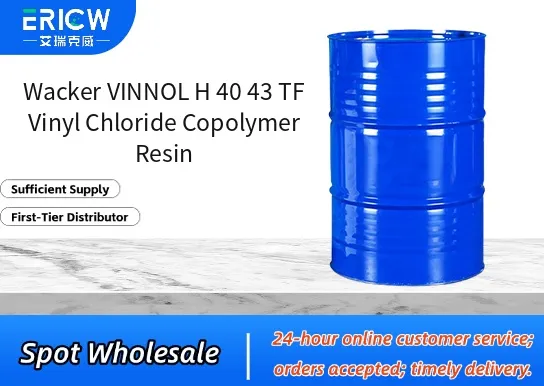
| Chemical Type | Vinyl chloride–vinyl acetate copolymer |
| Product Form | Free-flowing white powder |
| Appearance | White to off-white granular or powdery solid |
| K-Value (DIN 53726) | 40–43 |
| Volatile Matter (105 °C, 2 h) | ≤ 0.4 wt % |
| Residual Vinyl Chloride Monomer (VCM) | ≤ 1 ppm |
| Bulk Density | 450–550 g/L |
| Particle Size (d50) | 80–120 µm |
Contact With Us:
E-mail: wangxingqiang@ericwchem.com
Have a Questions? Call Us:
Add:
Building A1, Jiete Industrial Park, Huangpu District, Guangzhou City, Guangdong Province, China