English
 Español
 tiếng việt
 русский
Highly selective methanol synthesis catalyst optimized for low-pressure operation.
Enhanced thermal stability ensures consistent performance over extended operating cycles.
Low sintering tendency maintains active surface area and extends catalyst lifetime.
Robust resistance to sulfur and chloride poisoning under industrial feed conditions.
Uniform pellet morphology enables optimal pressure drop control in fixed-bed reactors.
Large-scale low-pressure methanol production from syngas.
Integration in CO₂-to-methanol processes with renewable hydrogen sources.
Revamp and capacity upgrade of existing methanol plants seeking higher conversion efficiency.
Small-to-medium scale modular methanol units requiring high start-up reliability.
Hybrid feed applications involving mixed syngas streams with variable CO/CO₂ ratios.
| Chemical Type | Cu/ZnO/Al₂O₃-based heterogeneous catalyst |
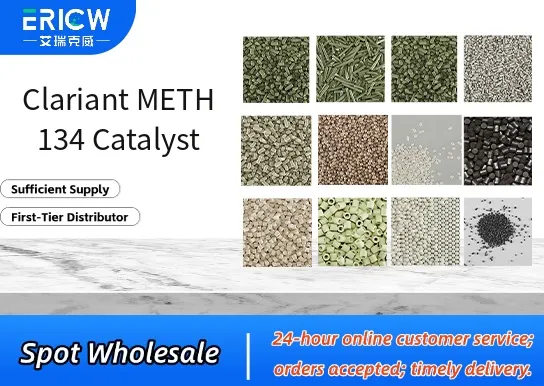
| Product Form | Cylindrical extrudates (5 mm diameter × 5–7 mm length) |
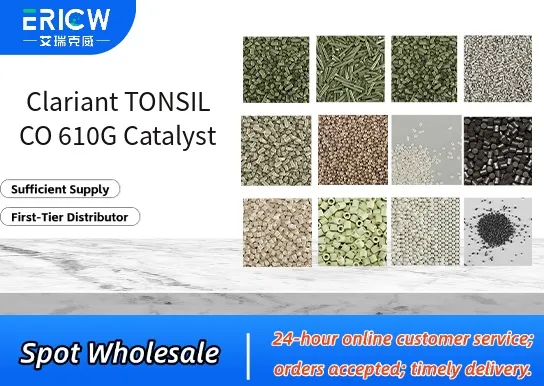
| Appearance | Gray-black free-flowing pellets |
| Primary Applications | Methanol synthesis from syngas (CO, CO₂, H₂) |
| Key Features | High low-pressure activity, sulfur tolerance, thermal resilience |
| Benefits | Reduced energy consumption, longer cycle life, lower catalyst replacement frequency |
| Storage Requirement | Store in dry, well-ventilated area; avoid exposure to moisture and air |
| Handling Precaution | Use appropriate PPE; avoid inhalation of dust during loading/unloading |
Q1: What is the primary function of Clariant METH 134 Catalyst in polymer synthesis?
A: Clariant METH 134 Catalyst is a high-performance, heterogeneous catalyst designed to promote methanolysis and transesterification reactions—particularly in the production of bio-based polyesters and specialty polyols. It enables efficient, selective bond cleavage and reformation under moderate temperature conditions while maintaining excellent thermal stability and minimal leaching.
Q2: Is METH 134 suitable for food-contact or pharmaceutical-grade applications?
A: METH 134 is formulated for industrial chemical synthesis and is not pre-qualified for direct food-contact or pharmaceutical use. Its suitability for regulated end-uses depends on full formulation assessment, process validation, and compliance with applicable regional regulatory frameworks—including thorough extractables and leachables evaluation by the end-user.
Q3: How does METH 134 compare to traditional homogeneous catalysts in terms of handling and separation?
A: Unlike many homogeneous catalysts, METH 134 is a solid, non-corrosive material that simplifies downstream processing: it can be readily separated via filtration or centrifugation, eliminates neutralization steps, reduces wastewater load, and avoids metal residue contamination in final products—enhancing both operational safety and product purity.
Q4: What are the recommended storage and handling precautions for METH 134?
A: Store METH 134 in its original sealed container in a cool, dry, well-ventilated area away from strong oxidizing agents and moisture sources. Handle using standard industrial hygiene practices—gloves and eye protection are advised during transfer or blending to prevent dust inhalation or skin contact. Avoid prolonged exposure to humid environments to preserve catalytic integrity.
Contact With Us:
E-mail: wangxingqiang@ericwchem.com
Have a Questions? Call Us:
Add:
Building A1, Jiete Industrial Park, Huangpu District, Guangzhou City, Guangdong Province, China