English
 Español
 tiếng việt
 русский
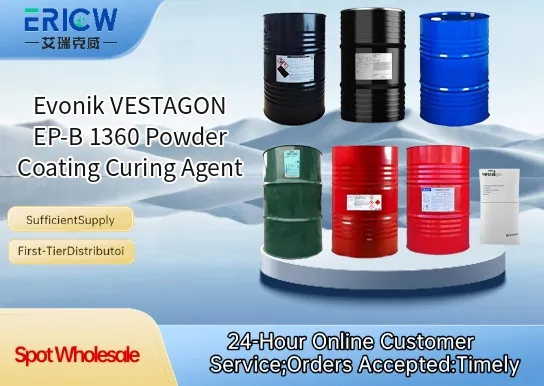
High reactivity with epoxy resins enabling fast cure at low temperatures (160–180 °C).
Excellent storage stability as a free-flowing, non-dusting powder.
Enables high-gloss, smooth finishes with superior mechanical and chemical resistance.
Low volatility and no formaldehyde release — compliant with stringent environmental and safety standards.
Consistent batch-to-batch performance supported by Evonik’s rigorous quality control.
Architectural aluminum profiles for façades and windows.
Automotive under-hood components requiring thermal and corrosion resistance.
Industrial appliances including washing machines, ovens, and HVAC enclosures.
Outdoor furniture and garden equipment exposed to UV and weathering.
Electrical enclosures and switchgear housings demanding dielectric integrity and durability.
| Chemical Type | Imidazoline-based latent curing agent |
| Product Form | Free-flowing white to off-white powder |
| Appearance | Fine, homogeneous powder without lumps |
| Primary Applications | Epoxy, epoxy-polyester, and hybrid powder coatings |
| Key Features | Latent reactivity, low-temperature cure, high crosslink density |
| Benefits | Energy savings, reduced VOC emissions, excellent film hardness and adhesion |
| Storage Stability | ≥12 months at ≤25 °C in original sealed packaging |
| Recommended Cure Schedule | 160–180 °C for 10–20 minutes |
Q1: What is the primary chemical functionality of VESTAGON EP-B 1360?
A: VESTAGON EP-B 1360 is a blocked aliphatic polyisocyanate curing agent, designed for use in thermosetting powder coatings. Its blocked structure provides excellent storage stability at ambient temperatures while enabling efficient crosslinking upon thermal activation during cure.
Q2: At what temperature range does EP-B 1360 typically initiate and complete crosslinking?
A: Crosslinking begins upon reaching the deblocking temperature, generally in the range of 140–160 °C, with full cure typically achieved within standard industrial powder coating bake cycles (e.g., 15–25 minutes at 160–180 °C). Optimal performance depends on formulation composition and thermal mass of the substrate.
Q3: Is EP-B 1360 compatible with standard epoxy, polyester, or hybrid powder resin systems?
A: EP-B 1360 is primarily formulated for use in polyester-based and polyester-epoxy hybrid powder coating systems. It is not recommended for pure epoxy resins due to reactivity mismatch, and compatibility with acrylic or polyurethane base resins should be verified experimentally.
Q4: How should EP-B 1360 be incorporated into a powder coating formulation?
A: It is typically dry-blended with the base resin and other additives prior to extrusion. Due to its reactive nature, thorough homogenization and controlled processing temperatures are essential to avoid premature deblocking or degradation during melt mixing.
Q5: What are key handling and storage recommendations for this product?
A: Store in original sealed containers under cool, dry conditions (below 25 °C) and protect from moisture and direct sunlight. Avoid prolonged exposure to elevated temperatures or humidity, as these may affect blocking stability and shelf life. Always follow Evonik’s safety data sheet for personal protective equipment and safe handling practices.
Contact With Us:
E-mail: wangxingqiang@ericwchem.com
Have a Questions? Call Us:
Add:
Building A1, Jiete Industrial Park, Huangpu District, Guangzhou City, Guangdong Province, China