English
 Español
 tiếng việt
 русский
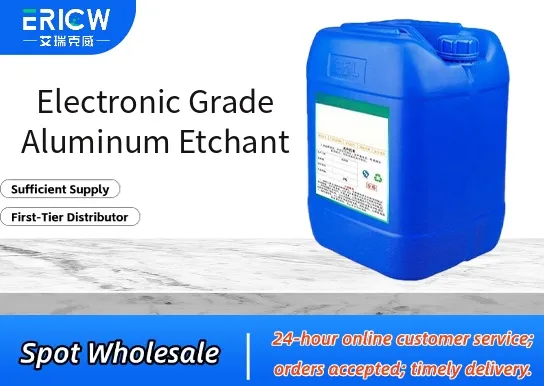
Ultra-low metallic impurity levels (<1 ppb for Na, K, Fe, Cu, Ni, Cr), meeting SEMI C12 and ASTM F2287 standards.
Controlled etch rate uniformity (±3% across 300 mm wafers) enabled by precise pH and temperature stability.
Non-oxidizing, chloride-free formulation minimizing interfacial corrosion and residue formation on Al–Si–Cu and Al–Cu metallization layers.
Compatible with automated wet bench dispensing systems and inline monitoring via real-time conductivity/pH sensors.
Low outgassing profile ensures minimal particle generation and reduced chamber contamination in cleanroom environments (Class 100 or better).
Front-end-of-line (FEOL) patterning of aluminum-based interconnect layers in CMOS and memory device fabrication.
Back-end-of-line (BEOL) etching of Al/Cu dual-damascene hard masks and bond pad metallization.
MEMS device fabrication requiring high-fidelity aluminum feature definition with sub-micron resolution.
Flat panel display (FPD) manufacturing for TFT aluminum gate electrode etching.
Advanced packaging processes including fan-out wafer-level packaging (FOWLP) and redistribution layer (RDL) patterning.
| Chemical Type | Phosphoric–acetic–nitric–water (PANW) based aqueous solution |
| Product Form | Liquid concentrate (ready-to-use or dilutable) |
| Appearance | Clear, colorless to pale yellow liquid; no suspended particles or haze |
| pH (as supplied, 25°C) | 1.2 – 1.6 |
| Primary Applications | Isotropic etching of aluminum, aluminum alloys (Al–Si, Al–Cu), and aluminum nitride thin films |
| Key Features | Low halide content (<5 ppm Cl⁻), ultra-high purity filtration (≤0.02 µm), certified for semiconductor use |
| Benefits | Minimizes galvanic corrosion, enables high selectivity over TiN/TiW barriers (>150:1), reduces post-etch residue |
| Regulatory Compliance | REACH SVHC compliant; RoHS 2015/863 Annex II compliant; non-REACH registered (exempt per Article 2(7)(a)) |
| Common Compatible Systems | Suitability |
| SEMI-compliant wet benches (e.g., SCREEN, Tokyo Electron, Lam Research) | Highly Recommended – Fully validated for recirculation, temperature control (35–55°C), and chemical resistance (PP, PVDF, PFA wetted parts) |
| Inline spray etch systems with multi-nozzle manifolds | Recommended – Requires optimized nozzle geometry and dwell time control to ensure uniform coverage |
| Batch immersion tanks with ultrasonic agitation | Suitable – Effective for R&D and low-volume production; requires strict bath life management and DI water rinse integration |
| Single-wafer spin-rinse-dry (SRD) platforms | Recommended – Compatible with programmable dispense profiles; validated for <100 nm Al line/space etching |
Q1: What is the CAS Registry Number for this etchant?
A: This is a proprietary multi-component formulation; individual CAS numbers are not assigned. Batch-specific certificates of analysis (CoA) list all reportable constituents per ICH Q5 and SEMI E19 guidelines.
Q2: What is the recommended etch rate range and how is it controlled?
A: Typical etch rate is 30–80 Å/sec at 45°C; rate is precisely tuned via temperature (±0.3°C), concentration (dilution ratio 1:0 to 1:3 v/v with UPW), and agitation intensity—validated per SEMI MF-1629.
Q3: How does this product compare to traditional phosphoric–nitric–acetic etchants in terms of residue and sidewall profile?
A: It delivers superior residue suppression (<0.05 particles/cm² after DI rinse) and near-vertical sidewalls (profile angle >88°) due to optimized surfactant-free surface tension control and absence of chloride-induced pitting.
Q4: Is this etchant subject to export controls or ITAR restrictions?
A: No. It is classified as EAR99 under the U.S. Export Administration Regulations (EAR) and is not subject to ITAR, Wassenaar Arrangement, or EU Dual-Use List controls.
Q5: Has extractables/leachables testing been performed for compatibility with high-purity UPW rinse systems?
A: Yes. Per SEMI F57-0318, extractables testing (IC-MS, ICP-MS) confirms <0.1 ppb organic leachables and <0.05 ppb metallic leachables after 72-hr contact with UPW-grade stainless steel (316L) and fluoropolymer components.
Contact With Us:
E-mail: wangxingqiang@ericwchem.com
Have a Questions? Call Us:
Add:
Building A1, Jiete Industrial Park, Huangpu District, Guangzhou City, Guangdong Province, China