English
 Español
 tiếng việt
 русский
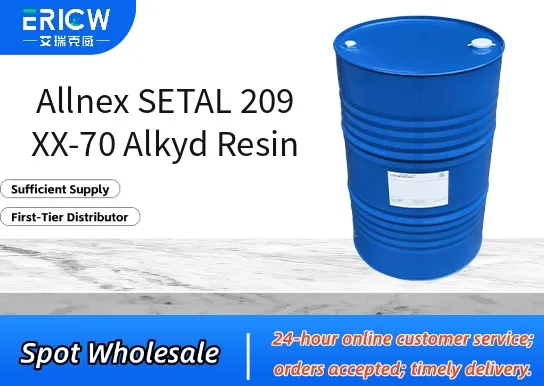
Medium-oil-length alkyd resin based on phthalic anhydride and soybean oil fatty acids.
Designed for excellent through-dry, hardness development, and gloss retention in air-drying coatings.
Offers balanced flexibility and chemical resistance suitable for general-purpose industrial finishes.
Compatible with common solvents, melamine formaldehyde resins, and other alkyd-modified systems.
Provides good pigment wetting and substrate adhesion on metal and wood substrates.
General-purpose air-drying industrial maintenance coatings.
Decorative and protective finishes for agricultural and construction equipment.
Wood furniture and cabinetry topcoats requiring moderate durability and aesthetic performance.
Undercoats and primers for metal substrates in OEM and aftermarket applications.
Low-VOC solventborne decorative paints for interior and exterior architectural use.
| Chemical Type | Phthalic–soybean oil alkyd resin |
| Product Form | Liquid solution in aromatic hydrocarbons (e.g., xylene) |
| Appearance | Clear, pale yellow to amber viscous liquid |
| Non-Volatile Content (NV%) | ~60–65% (as supplied) |
| Acid Value | 6–10 mg KOH/g |
| Saponification Value | 180–200 mg KOH/g |
| Iodine Value | 130–150 g I₂/100 g |
| Viscosity (25°C, Brookfield LVT, Spindle #4, 20 rpm) | ~1,200–2,000 cP |
Q1: What is the primary application area for SETAL 209 XX-70?
A: SETAL 209 XX-70 is a solvent-borne short-oil alkyd resin designed primarily for high-gloss decorative and protective coatings, including interior and exterior architectural paints, wood finishes, and general-purpose industrial maintenance coatings where excellent flow, leveling, and gloss retention are required.
Q2: Is SETAL 209 XX-70 compatible with common co-resins and additives?
A: Yes, it demonstrates good compatibility with typical alkyd modifiers such as melamine-formaldehyde resins, urea-formaldehyde resins, and phenolic resins. It also integrates well with conventional pigment dispersants, defoamers, and rheology modifiers used in solvent-based systems—though compatibility testing under actual formulation conditions is recommended.
Q3: How does SETAL 209 XX-70 perform in terms of drying and film formation?
A: As a cobalt-free, air-drying alkyd resin, it offers balanced through-dry and surface-dry characteristics in standard solvent-based formulations. Film formation is robust under ambient curing conditions, delivering good hardness development and resistance to early water spotting when properly formulated.
Q4: Can SETAL 209 XX-70 be used in low-VOC formulations?
A: While inherently solvent-borne, it can contribute to VOC-reduced systems when blended with reactive diluents or higher-solids alkyds—and its formulation flexibility supports compliance with regional VOC limits when optimized alongside appropriate solvents and co-binders.
Contact With Us:
E-mail: wangxingqiang@ericwchem.com
Have a Questions? Call Us:
Add:
Building A1, Jiete Industrial Park, Huangpu District, Guangzhou City, Guangdong Province, China