English
 Español
 tiếng việt
 русский
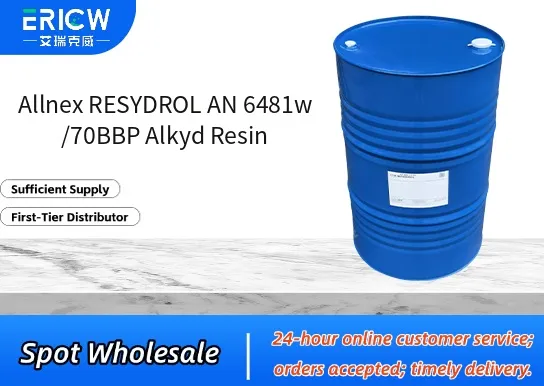
Water-reducible alkyd resin enabling low-VOC, high-performance coatings without sacrificing film integrity.
Excellent balance of hardness development and flexibility for durable, impact-resistant finishes.
Good compatibility with acrylic emulsions and other waterborne resins for hybrid formulation versatility.
Fast ambient cure kinetics with efficient coalescence, supporting rapid production throughput.
Low yellowing tendency and high clarity, ideal for white and pastel decorative coatings.
Interior architectural wall paints requiring washability and scrub resistance.
Wood furniture and cabinetry coatings demanding smooth flow and gloss retention.
Metal primers and topcoats for general industrial maintenance applications.
DIY and professional-grade decorative enamels for residential and commercial use.
| Chemical Type | Water-reducible alkyd resin (modified phthalic-based) |
| Product Form | Aqueous dispersion |
| Appearance | Opaque white to off-white liquid |
| Solids Content | ~70 ± 1 wt% |
| pH | 8.0 – 9.0 |
| Viscosity (Brookfield RVT, sp31, 2 rpm, 25°C) | 1,500 – 3,500 mPa·s |
| Minimum Film Formation Temperature (MFFT) | ~20°C |
| Primary Applications | Waterborne decorative and protective coatings |
Q1: What is the primary application of RESYDROL AN 6481w/70BBP in coating systems?
A: RESYDROL AN 6481w/70BBP is a water-reducible alkyd resin designed for use in high-performance, low-VOC decorative and protective coatings—particularly interior and exterior architectural paints, wood finishes, and maintenance coatings where balanced drying, gloss retention, and substrate adhesion are required.
Q2: How does this resin achieve water reducibility without compromising film integrity?
A: The resin incorporates carefully balanced hydrophilic functional groups and optimized molecular architecture, enabling stable dispersion in water-based systems while maintaining good coalescence, film formation, and resistance to water spotting after cure.
Q3: Is RESYDROL AN 6481w/70BBP compatible with common acrylic or polyurethane dispersions?
A: Yes—it is formulated for broad compatibility with standard anionic and non-ionic acrylic dispersions, as well as aliphatic polyurethane dispersions, supporting hybrid formulations that leverage both alkyd performance and synthetic polymer durability.
Q4: What type of curing mechanism does this alkyd resin rely on?
A: It cures primarily via oxidative crosslinking in ambient air, enhanced by metal driers when used in conventional formulations; in water-reduced systems, it may also contribute to physical film formation through particle coalescence and secondary crosslinking upon water evaporation.
Q5: Can this resin be used in low-odor, eco-label compliant coatings?
A: Yes—its water-reducible nature supports significant VOC reduction, and it is suitable for formulations targeting major eco-labels (e.g., EU Ecolabel, Green Seal), provided the full formulation—including additives and pigments—meets relevant criteria.
Contact With Us:
E-mail: wangxingqiang@ericwchem.com
Have a Questions? Call Us:
Add:
Building A1, Jiete Industrial Park, Huangpu District, Guangzhou City, Guangdong Province, China