English
 Español
 tiếng việt
 русский
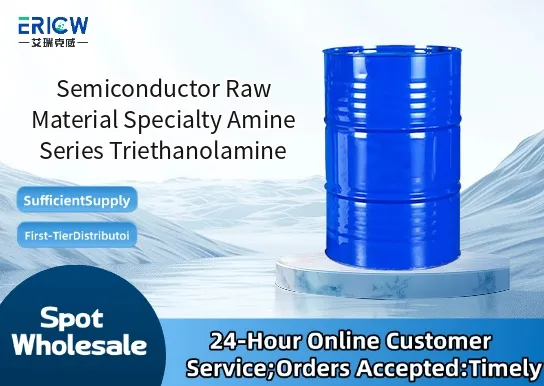
Ultra-high purity (≥99.95%) with stringent trace metal control (<10 ppb Fe, Cu, Ni, Na, K), meeting semiconductor-grade cleanliness requirements.
Low volatility and excellent thermal stability up to 180°C, ensuring process consistency in high-temperature wafer cleaning and polishing formulations.
Controlled amine functionality with minimal diethanolamine (DEA) and monoethanolamine (MEA) impurities (<50 ppm each), reducing risk of residue formation on sensitive device surfaces.
Non-volatile, non-corrosive, and compatible with ultra-low-particulate handling environments (Class 10 cleanroom compliant packaging).
Batch-to-batch reproducibility certified via GC-MS, IC, and ICP-MS analytical reports for every production lot.
Formulation component in post-CMP (Chemical Mechanical Planarization) slurry stabilizers and pH buffers for copper and low-k dielectric processing.
Chelating agent in wafer surface passivation solutions to suppress metal ion leaching during wet etch and rinse steps.
Viscosity modifier and co-solvent in photoresist stripper and organic solvent-based cleaning blends for advanced node (≤7 nm) logic and memory devices.
pH regulator in ultrapure water (UPW)-compatible cleaning chemistries for front-end-of-line (FEOL) gate oxide protection.
Stabilizer for nanoparticle dispersions used in next-generation EUV mask cleaning formulations.
| Chemical Type | Tertiary alkanolamine (Triethanolamine, C₆H₁₅NO₃) |
| Product Form | Clear, colorless to pale yellow liquid |
| Appearance | Transparent, homogeneous, free of suspended particles or haze |
| Melting Point | 20.5–21.5°C |
| Boiling Point (at 760 mmHg) | 360°C (decomposes above 330°C) |
| Primary Applications | Semiconductor wet process chemicals: CMP additives, cleaning formulations, etch inhibitors, and photoresist removers |
| Key Features | Ultra-low metallic impurities, high batch consistency, low DEA/MEA byproducts, UPW-compatible |
| Regulatory Compliance | REACH registered; RoHS 2.0 compliant; no SVHCs listed under Annex XIV; SDS available per ISO 11014 |
| Common Compatible Systems | Suitability |
| Aqueous-based CMP slurries (SiO₂ & CeO₂) | Highly Recommended – Enhances dispersion stability and pH buffering capacity without agglomeration |
| Organic solvent systems (PGMEA, γ-butyrolactone, NMP) | Recommended – Fully miscible; improves solubility of metal chelators and surfactants |
| Ultrapure water (UPW) rinse formulations | Highly Recommended – Non-ionic, low-conductivity, leaves no ionic residue after drying |
| Photoresist stripper concentrates (amine-based) | Suitable – Acts as synergistic co-base; reduces required concentration of primary amines |
Q1: What is the CAS Number for this specialty-grade triethanolamine?
A: The CAS Registry Number is 102-71-6. This refers specifically to the ultra-high-purity semiconductor grade described herein — distinct from technical or pharmaceutical grades.
Q2: What is the recommended usage concentration in CMP slurry formulations?
A: Typical dosage ranges from 0.05–0.3 wt% in final slurry; optimal concentration is formulation-specific and validated via zeta potential and particle size distribution testing.
Q3: How does this specialty amine differ from standard triethanolamine in terms of extractables and leachables?
A: Unlike commodity grades, this variant undergoes multi-stage vacuum distillation and sub-micron filtration, reducing volatile organic extractables by >99% and eliminating detectable leachables (e.g., nitrosamines, residual solvents) per USP <661.2> and SEMI F57 test methods.
Q4: Is this material certified for use in ISO Class 1 cleanrooms?
A: Yes — packaged in double-bagged, nitrogen-purged HDPE carboys with 0.2 µm PTFE vent filters; certified for ≤1 particle ≥0.5 µm per mL (per ISO 14644-1 Class 1 airborne particulate limits at rest).
Contact With Us:
E-mail: wangxingqiang@ericwchem.com
Have a Questions? Call Us:
Add:
Building A1, Jiete Industrial Park, Huangpu District, Guangzhou City, Guangdong Province, China