English
 Español
 tiếng việt
 русский
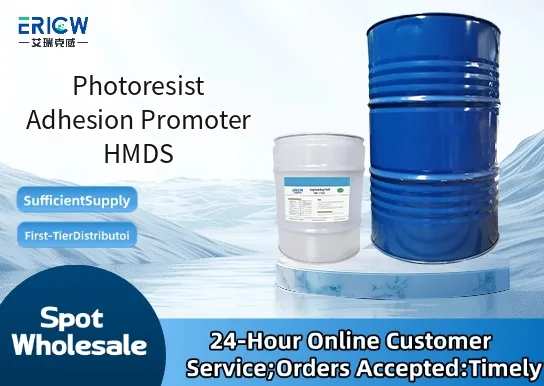
Hexamethyldisilazane (HMDS) based formulation optimized for uniform, vapor-phase deposition on silicon, glass, and metal oxide substrates.
Significantly enhances photoresist adhesion by converting surface hydroxyl (–OH) groups into hydrophobic trimethylsilyl (–OSi(CH₃)₃) moieties.
Low-residue, high-purity grade minimizes particulate generation and pattern defects in sub-micron lithography processes.
Compatible with both batch and single-wafer spin-coating and vapor priming tools—enabling seamless integration into existing cleanroom workflows.
Stable shelf life (>24 months unopened) under inert, moisture-free storage conditions at room temperature.
Semiconductor front-end manufacturing: pre-photoresist priming for CMOS, MEMS, and power device fabrication.
Advanced packaging: wafer-level packaging (WLP), TSV (through-silicon via), and fan-out RDL (redistribution layer) patterning.
Microfluidics and lab-on-a-chip device fabrication on fused silica, quartz, and silicon nitride substrates.
Optoelectronics and display production: OLED backplane patterning, micro-LED transfer mask alignment layers.
MEMS sensor manufacturing requiring high-fidelity resist adhesion on high-aspect-ratio or chemically heterogeneous surfaces.
| Chemical Type | Hexamethyldisilazane (HMDS), ≥99.5% purity |
| Product Form | Clear, colorless liquid (vapor-phase precursor); supplied in sealed amber HDPE bottles or stainless-steel cylinders for vapor delivery systems |
| Appearance | Transparent, mobile liquid with characteristic amine-like odor |
| Melting Point | −10 °C (typ.) |
| Boiling Point | 126–127 °C at 760 mmHg |
| Primary Applications | Photoresist adhesion promotion prior to positive/negative tone resist coating (e.g., AZ®, Shipley®, Tokyo Ohka resists) |
| Key Features | Vapor-phase compatibility; low volatility control; minimal residual silicon contamination; non-corrosive to aluminum and copper interconnects |
| Regulatory Compliance | REACH registered; RoHS compliant; no SVHC substances above threshold per current Annex XIV |
| Common Compatible Systems | Suitability |
| TEL Clean Track™ Lithography Track (ACT series) | Highly Recommended – Fully validated for vapor priming mode with integrated HMDS delivery modules |
| Canon FPA & Nikon SSB Stepper/Scanner Coater-Developer Tracks | Highly Recommended – Supports inline HMDS priming with precise temperature and dwell-time control |
| Spin coater systems (e.g., Laurell WS-650, Headway EC301) | Recommended – Requires optional HMDS vapor chamber or manual dip-prime protocol |
| Batch-style hotplate priming systems (e.g., Novellus / Lam Vantage) | Suitable – Effective with controlled N₂ carrier gas flow and substrate temperature set at 180–220 °C |
Q1: What is the CAS Registry Number for HMDS used in this product?
A: The CAS Number for hexamethyldisilazane is 999-97-3. Our HMDS Adhesion Promoter is manufactured to meet semiconductor-grade impurity limits (<10 ppb metals, <50 ppm water).
Q2: What is the typical HMDS consumption rate per 200-mm wafer in vapor priming mode?
A: Average consumption is 0.15–0.25 mL per 200-mm wafer under standard process conditions (180 °C, 60 s dwell, 50 sccm N₂ purge). Actual usage depends on chamber geometry, pressure, and substrate surface area.
Q3: How does HMDS compare to alternative adhesion promoters like APTMS or OTS?
A: HMDS offers superior thermal stability, lower decomposition residue, and faster, more uniform monolayer formation via vapor-phase reaction. Unlike APTMS (aqueous instability) or OTS (longer curing times), HMDS enables rapid, dry processing ideal for high-throughput fabs.
Q4: Is HMDS subject to migration or leaching after resist development and etch steps?
A: No—HMDS forms a covalent Si–O–Si bond with substrate hydroxyls and is thermally stable up to 300 °C. It does not migrate or extract during aqueous TMAH development, plasma etch, or wet cleans; residual carbon content remains below detection limit (XPS).
Contact With Us:
E-mail: wangxingqiang@ericwchem.com
Have a Questions? Call Us:
Add:
Building A1, Jiete Industrial Park, Huangpu District, Guangzhou City, Guangdong Province, China