English
 Español
 tiếng việt
 русский
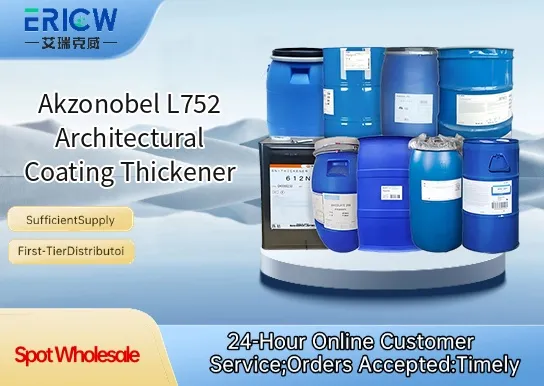
Non-ionic associative thickener delivering excellent rheology control in waterborne architectural coatings.
Provides outstanding sag resistance and brush/roller drag performance without compromising flow and leveling.
Compatible with a broad range of latex polymers, pigments, and common formulation additives.
Enables low-VOC and zero-VOC formulations while maintaining high shear viscosity stability.
Delivers consistent thickening efficiency across varying pH ranges (6.0–10.0) and temperatures.
Interior and exterior flat/matte wall paints.
Low-sheen and satin finish architectural coatings.
Textured decorative finishes and elastomeric coatings.
Primer-sealers and dry-fall paints for commercial applications.
Water-based masonry and concrete protective coatings.
| Chemical Type | Non-ionic hydrophobically modified ethoxylated urethane (HEUR) |
| Product Form | Clear to slightly hazy aqueous solution |
| Appearance | Colorless to pale yellow liquid |
| Active Content | Approx. 30 wt% in water |
| pH (1% in water) | 6.5–8.5 |
| Viscosity (25°C, Brookfield RVT, Spindle #3, 20 rpm) | 1,500–4,000 mPa·s |
| Freeze-Thaw Stability | Stable after 3 cycles (−18°C × 16 h / 23°C × 8 h) |
| Primary Applications | Rheology modifier for waterborne architectural paints and coatings |
Q1: What type of rheology modifier is L752, and how does it function in architectural coatings?
A: AkzoNobel L752 is a hydrophobically modified ethoxylated urethane (HEUR) thickener. It functions by forming transient, reversible associative networks between hydrophobic end groups and other hydrophobic domains in the coating—such as surfactants, resins, or pigments—resulting in shear-thinning behavior, improved sag resistance, and enhanced brush/roller application properties.
Q2: Is L752 compatible with common architectural coating systems, including low-VOC and zero-VOC formulations?
A: Yes, L752 is widely used in both conventional and modern low-VOC and zero-VOC architectural paints, including acrylic, vinyl-acrylic, and styrene-acrylic dispersions. Its non-ionic nature and lack of electrolytes make it suitable for formulations sensitive to ionic interference or pH instability.
Q3: How should L752 be incorporated into a paint formulation to ensure optimal performance?
A: L752 is typically added during the let-down stage, after pigment grinding and under moderate agitation. Pre-dilution with water or co-solvent (e.g., propylene glycol) is recommended to facilitate uniform dispersion. Avoid high-shear addition directly into highly hydrophobic phases, as this may hinder associative network development.
Q4: Does L752 provide viscosity stability over time and under varying storage conditions?
A: When properly formulated and dispersed, L752 delivers good long-term viscosity stability across typical storage temperature ranges (5–40 °C). Its associative mechanism is less prone to microbial degradation than cellulosic thickeners, though compatibility with preservative systems should still be verified in final formulations.
Contact With Us:
E-mail: wangxingqiang@ericwchem.com
Have a Questions? Call Us:
Add:
Building A1, Jiete Industrial Park, Huangpu District, Guangzhou City, Guangdong Province, China