English
 Español
 tiếng việt
 русский
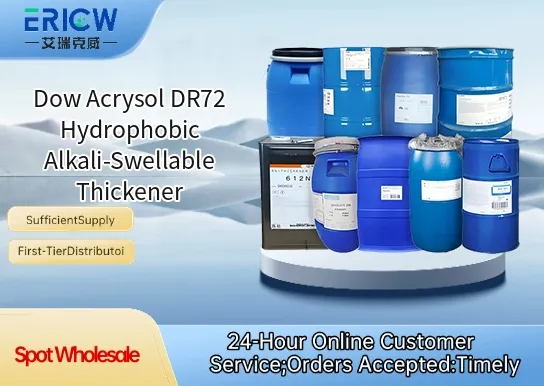
Delivers high mid-shear viscosity and excellent flow/leveling balance in waterborne coatings.
Provides superior resistance to water, surfactants, and electrolytes due to hydrophobic modification.
Enables robust rheology control across wide pH range (pH 7–10) with minimal sensitivity to alkaline neutralization variations.
Offers low foaming characteristics and good compatibility with common co-thickeners and associative thickeners.
Improves sag resistance on vertical surfaces without compromising brushability or spray atomization.
Interior and exterior architectural latex paints.
Textured coatings and elastomeric wall systems.
Primer and sealer formulations for masonry and drywall.
Low-VOC and zero-VOC decorative coatings.
Industrial maintenance coatings requiring water resistance and film integrity.
| Chemical Type | Hydrophobically modified alkali-swellable emulsion (HASE) |
| Product Form | Aqueous dispersion |
| Appearance | Off-white to light tan viscous liquid |
| pH (as supplied) | 2.5–4.0 |
| Active Content | 28–32 wt% |
| Viscosity (Brookfield RVT, spindle #3, 20 rpm, 25°C) | 1,500–4,500 cP |
| Primary Applications | Rheology modifier for waterborne architectural and industrial coatings |
| Key Features | Hydrophobic association, alkali-activated swelling, non-ionic surfactant tolerance |
Q1: How does DR72 differ from conventional non-associative alkali-swellable thickeners?
A: DR72 is a hydrophobically modified alkali-swellable emulsion (HASE) thickener, offering enhanced rheology control—including improved sag resistance, better leveling, and superior shear-thinning behavior—compared to traditional non-associative ASE thickeners. Its hydrophobic groups enable transient intermolecular associations that reinforce the thickened network under rest conditions.
Q2: What pH range is required for optimal viscosity development with DR72?
A: DR72 requires alkaline activation to fully ionize its carboxylic acid groups and achieve target viscosity. Effective thickening typically begins above pH 7.5 and reaches full performance in the pH range of 8.0–9.5. Formulators should ensure stable pH during storage and use, as viscosity may decrease significantly below pH 7.0.
Q3: Is DR72 compatible with common co-thickeners and rheology modifiers used in architectural coatings?
A: Yes, DR72 is widely used in combination with cellulosic thickeners (e.g., HEC) and associative polyurethane (HEUR) thickeners to balance application properties such as spatter resistance, brush drag, and film build. Compatibility testing is recommended when blending with high-ionic-strength additives or certain biocides.
Q4: How should DR72 be incorporated into water-based formulations?
A: DR72 is typically added during the let-down stage, after primary pigment dispersion and at a pH ≥ 8.0. It should be diluted with deionized water or formulation water prior to addition and mixed under moderate agitation to ensure uniform distribution. Avoid high-shear mixing post-addition to prevent mechanical degradation of the associative network.
Q5: What are the key storage and handling considerations for DR72?
A: Store DR72 in tightly sealed containers at temperatures between 5 °C and 35 °C, away from freezing and prolonged exposure to UV light or excessive heat. The product is supplied as a stable aqueous emulsion and should not be allowed to dry out. Avoid contamination with strong acids, aldehydes, or highly reactive biocides, which may compromise stability or performance.
Contact With Us:
E-mail: wangxingqiang@ericwchem.com
Have a Questions? Call Us:
Add:
Building A1, Jiete Industrial Park, Huangpu District, Guangzhou City, Guangdong Province, China