English
 Español
 tiếng việt
 русский
High chroma and excellent lightfastness (Blue Shade, ASTM D2807 Grade 7–8)
Outstanding thermal stability up to 220 °C for high-temperature processing
Good dispersibility in organic media including PVC, polyolefins, and engineering plastics
Low migration tendency in polymer matrices, ensuring color integrity during service life
Compliant with major global regulatory frameworks including EU REACH and US FDA 21 CFR §178.3290 for indirect food contact applications
Automotive interior plastics (dashboards, trim components)
Packaging films and rigid containers requiring food-contact compliance
Wire & cable insulation for demanding electrical and flame-retardant applications
Industrial coatings requiring long-term UV resistance and weathering performance
Masterbatch production for polypropylene (PP), polyethylene (PE), and ABS
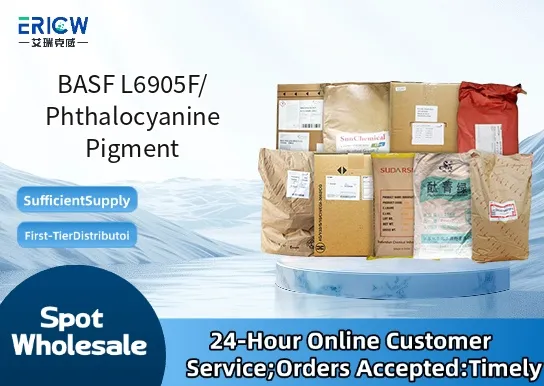
| Chemical Type | Copper phthalocyanine (CuPc), β-phase |
| Product Form | Free-flowing fine powder |
| Appearance | Intense greenish-blue crystalline pigment |
| Primary Applications | Polymer coloring, masterbatches, coatings, inks |
| Key Features | High heat stability, low volatility, excellent dispersibility |
| Benefits | Consistent batch-to-batch color, minimal filter clogging, low dust generation |
| Regulatory Status | REACH registered; compliant with ISO 8130-13 for pigment dispersion quality |
| Storage Conditions | Store in cool, dry, well-ventilated area; avoid direct sunlight and moisture |
Q1: What is the primary chemical class and typical hue profile of BASF L6905F?
A: BASF L6905F is a copper phthalocyanine-based pigment, delivering a clean, high-strength greenish-blue shade with excellent chroma and lightfastness. Its molecular structure provides inherent stability in demanding polymer and coating applications.
Q2: Is BASF L6905F suitable for use in food-contact plastics?
A: BASF L6905F is designed for industrial applications and is not pre-approved for direct food-contact use under major global regulatory frameworks. Customers must conduct full regulatory assessment—including migration testing and compliance verification—based on their specific formulation, processing conditions, and target market requirements.
Q3: How does L6905F perform in high-temperature polymer processing?
A: This pigment demonstrates good thermal stability and is commonly used in engineering thermoplastics processed at elevated temperatures, including polyolefins and certain polyesters. Performance depends on residence time, shear history, and matrix compatibility—pre-dispersion and process optimization are recommended to maintain color consistency and dispersion quality.
Q4: What are common dispersion methods for optimal performance in coatings or inks?
A: For best results, L6905F is typically incorporated via high-shear dispersion using suitable wetting agents and rheology modifiers. Pre-dispersed paste or masterbatch forms are widely employed to ensure uniform distribution and minimize agglomeration, especially in solvent-borne and high-solids systems.
Contact With Us:
E-mail: wangxingqiang@ericwchem.com
Have a Questions? Call Us:
Add:
Building A1, Jiete Industrial Park, Huangpu District, Guangzhou City, Guangdong Province, China