English
 Español
 tiếng việt
 русский
Highly selective acid catalyst for controlled condensation and esterification reactions.
Thermally stable solid catalyst enabling operation at elevated temperatures without leaching.
Non-corrosive alternative to liquid mineral acids, enhancing process safety and equipment longevity.
Easy separation and recyclability due to granular, insoluble solid form.
Consistent batch-to-batch performance supported by stringent Clariant quality control.
Ester synthesis in fragrance and flavor intermediates production.
Dehydration reactions for unsaturated polyester resin precursors.
Acetalization processes in pharmaceutical fine chemical manufacturing.
Transesterification in bio-based plasticizer development.
Condensation polymerization for specialty polyethers and silicones.
| Chemical Type | Solid acidic clay-based catalyst |
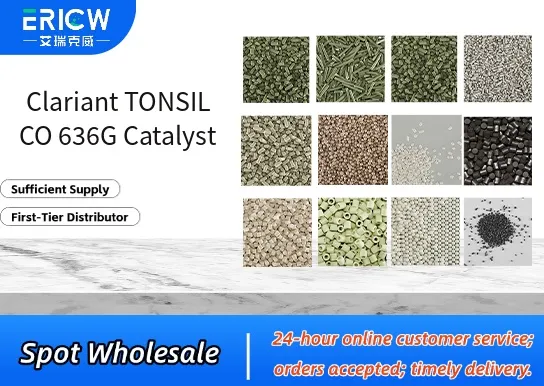
| Product Form | Free-flowing granules |
| Appearance | Light beige to tan granules |
| Primary Applications | Esterification, acetalization, dehydration, condensation |
| Key Features | Non-corrosive, heterogeneous, reusable |
| Benefits | Reduced waste, simplified downstream separation, lower maintenance costs |
| Storage Conditions | Store in dry, well-ventilated area; protect from moisture |
| Regulatory Status | REACH registered; no SVHCs above threshold |
Q1: What is the primary function of TONSIL CO 636G in polymer processing?
A: TONSIL CO 636G is a highly active clay-based catalyst designed to promote controlled crosslinking and condensation reactions—particularly in silicone and hybrid polymer systems—enhancing thermal stability, mechanical integrity, and cure efficiency without excessive volatility or residue formation.
Q2: Is TONSIL CO 636G compatible with food-contact or pharmaceutical-grade formulations?
A: While TONSIL CO 636G is not pre-qualified for direct food-contact or pharmaceutical use, it may be considered for certain non-migrating, high-purity applications where regulatory compliance is verified through full system testing and end-product validation by the formulator.
Q3: How should TONSIL CO 636G be incorporated into a formulation?
A: It is typically added during the high-shear mixing stage under inert or low-moisture conditions to ensure uniform dispersion. Pre-drying is recommended if ambient humidity is elevated, and compatibility with other additives should be confirmed via small-scale trials before full-scale implementation.
Q4: Does TONSIL CO 636G require activation or pre-treatment prior to use?
A: No thermal or chemical activation is required—TONSIL CO 636G is supplied in an optimally conditioned state for immediate use. However, storage in a cool, dry environment is advised to maintain catalytic consistency and prevent moisture uptake.
Q5: Can TONSIL CO 636G be used in solvent-free or high-solid-content systems?
A: Yes—it performs effectively in low-VOC and solvent-free formulations, including reactive hot-melt adhesives and high-solids coatings, where its high surface area and tailored acidity support efficient catalysis without compromising viscosity control or pot life.
Contact With Us:
E-mail: wangxingqiang@ericwchem.com
Have a Questions? Call Us:
Add:
Building A1, Jiete Industrial Park, Huangpu District, Guangzhou City, Guangdong Province, China