English
 Español
 tiếng việt
 русский
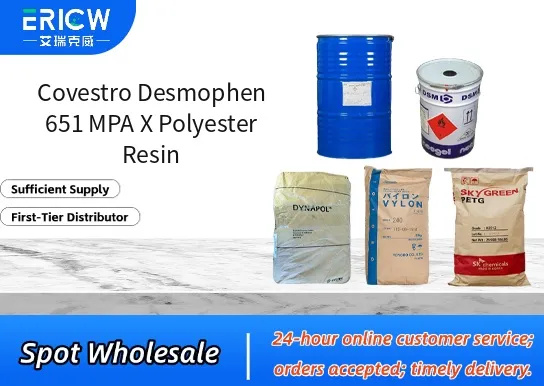
Highly reactive aliphatic polyester polyol with terminal hydroxyl functionality for fast-curing systems.
Excellent hydrolytic stability due to saturated backbone and absence of ester groups prone to degradation.
Low viscosity enables easy handling, efficient mixing, and improved filler incorporation in formulations.
Designed for compatibility with isocyanates in high-performance polyurethane coatings and adhesives.
Consistent batch-to-batch quality supported by Covestro’s stringent GMP-aligned manufacturing control.
High-gloss, weather-resistant topcoats for automotive OEM and refinish applications.
Durable protective coatings for industrial metal and plastic substrates.
Two-component polyurethane adhesives for demanding bonding in transportation and construction.
Flexible yet abrasion-resistant clearcoats for flooring and decorative surfaces.
| Chemical Type | Aliphatic polyester polyol (difunctional) |
| Product Form | Liquid |
| Appearance | Clear, pale yellow liquid |
| Hydroxyl Value (OHV) | 54–58 mg KOH/g |
| Acid Value | ≤ 1.0 mg KOH/g |
| Viscosity (25 °C) | 1,800–2,400 mPa·s |
| Water Content | ≤ 0.05 wt.% |
| Functionality (f) | ≈ 2.0 |
Q1: What is the primary function of Desmophen 651 MPA X in polyester resin systems?
A: Desmophen 651 MPA X functions as a reactive polyol modifier that enhances flexibility, impact resistance, and hydrolytic stability in unsaturated polyester resins—particularly in demanding applications such as high-performance gel coats and structural composites.
Q2: Is Desmophen 651 MPA X compatible with standard styrene-based unsaturated polyester resins?
A: Yes, it is fully miscible with conventional styrenated unsaturated polyester resins and integrates smoothly during the resin manufacturing or compounding stage without phase separation or viscosity instability under typical processing conditions.
Q3: How does Desmophen 651 MPA X affect cure kinetics and final mechanical properties?
A: It generally maintains compatibility with common peroxide initiators and does not significantly delay gel time; however, it contributes to improved elongation at break and reduced brittleness in the cured network while preserving tensile strength and hardness within typical formulation windows.
Q4: Can Desmophen 651 MPA X be used in low-VOC or high-solids polyester formulations?
A: Yes—it supports VOC reduction strategies due to its high molecular weight and low volatility, and it can be incorporated into high-solids systems without compromising pot life or film formation integrity.
Q5: What storage and handling precautions are recommended for this product?
A: Store in tightly sealed containers under dry, cool conditions (below 30 °C) and protect from moisture and prolonged exposure to air to prevent surface skinning or viscosity increase over time.
Contact With Us:
E-mail: wangxingqiang@ericwchem.com
Have a Questions? Call Us:
Add:
Building A1, Jiete Industrial Park, Huangpu District, Guangzhou City, Guangdong Province, China